 Bhavani Krishnan
Agile gave organizations faster delivery, cross-functional teams, and shorter feedback loops. None of that goes away in the AI era. What changes is the operating model around those teams: who makes decisions, on what cadence, with what evidence, and increasingly with what non-human contributors in the loop. McKinsey is calling it the agentic organization, BCG frames it as a workforce transformation, and the OpenAI Frontier Alliances announced in February 2026 with BCG, McKinsey, Accenture, and Capgemini exist to help enterprises rewire for it. The Path to Agility® approach extends cleanly into this new layer because it was built on capability and business-outcome scoring rather than practice adoption. This post breaks down what specifically has to change in the operating model, and how to measure whether your organization has made the shift.
Key Takeaways
- Agile practices are necessary but no longer sufficient. Daily syncs and sprints still work; what changes is the operating model around them: decision rights, governance cadence, and team composition.
- The 2026 consulting narrative is unified. McKinsey's "agentic organization," BCG's workforce-transformation thesis, and the OpenAI Frontier Alliances all argue that AI requires operating-model redesign, not isolated tool adoption.
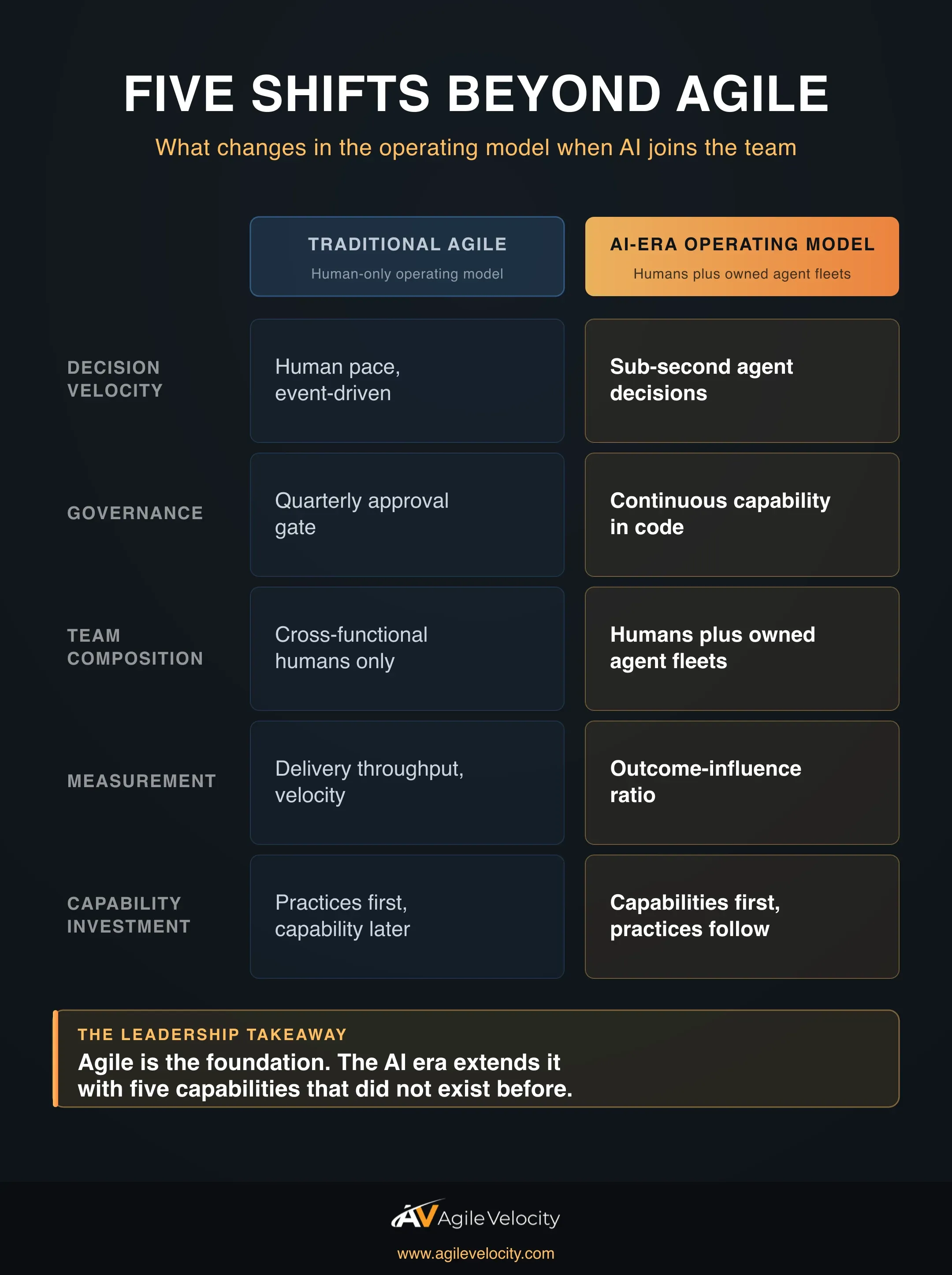
- Five things change in the operating model: decision velocity moves below the human layer, governance becomes continuous, teams add non-human contributors, measurement shifts from throughput to outcome influence, and capability investment outpaces practice adoption.
- High performers redesign workflows end-to-end. Per BCG's 2026 reporting, organizations that capture AI value are 3× more likely to redesign workflows in depth versus those running isolated pilots.
- Path to Agility's capability-and-outcome scoring carries over. The 9 Business Outcomes still anchor the measurement; what changes is which of the 100 capabilities matter most when AI sits in the workflow.
Why Agile Stops Being Enough in an AI-Native Operating Model
Agile was built for a world where humans were the only contributors inside the cross-functional team. Sprints, daily syncs, and retrospectives are designed around human coordination, human estimation, human judgment. When the operating model adds non-human contributors (software agents that draft code, classify customer messages, generate forecasts, surface anomalies), the surrounding scaffolding starts to creak.
The teams still run their events. The board still tracks throughput. But three things break quietly. First, the unit of decision shifts. An agent makes hundreds of micro-decisions per minute that an agile team would previously have collected, batched, and reviewed at the daily sync. Second, governance lag becomes a liability. A quarterly governance gate that worked when teams shipped every two weeks fails when an agent can ship a faulty classifier in two hours. Third, the measurement frame goes stale. Cycle time and velocity describe human output. They do not describe what the agent fleet inside the team is doing or whether it is producing the business outcome leadership funded.
This is the gap the 2026 consulting literature is naming. The fix is not "more AI." It is operating-model redesign that makes the existing agile scaffolding work alongside the new contributors.
What Has to Change: The Five Shifts
There are five structural shifts that distinguish an AI-era operating model from a traditional agile one. Each shift creates a new capability requirement that needs to be measured and built, not a new event to add to the team's calendar.
Decision velocity moves below the human layer
In a traditional agile team, decisions land on humans through events: refinement, planning, demo, retro. In an AI-era operating model, a meaningful fraction of decisions land on software agents that operate at sub-second velocity. Leaders cannot make every classification call, every routing call, every prioritization call when there are millions of them per hour. The operating-model shift is to define which decisions stay human and which delegate, on what evidence, and with what reversal mechanism. Agile teams that skip this step end up with agents making consequential decisions inside a process that assumed only humans were making them.
Governance becomes a continuous capability
Quarterly governance cadence was a reasonable approximation of risk when humans shipped every sprint. It collapses when agents can ship behavior changes in minutes. Continuous governance is the AI-era replacement: drift monitoring, calibrated rollback, ethical pre-launch review, and an explicit risk-acceptance flow that does not require a steering committee meeting. The capability is "governance as code," not "governance as calendar."
Teams include non-human contributors
Cross-functional team composition stops being purely human. A team's "members" now include the agents it operates, with explicit responsibility for those agents' inputs, outputs, drift, and incident response. The shift is to treat agent fleets as a team capability with named owners and a defined scope, not as ambient infrastructure that "just works."
Measurement shifts from delivery throughput to outcome influence
Velocity, cycle time, and throughput are about how much a team produces. In an AI-era operating model, leaders need to know how much of the business outcome the team is influencing, including via the agents in its workflow. The leading indicator is outcome-influence ratio: of the business outcome moves we tracked this quarter, how many traced back to capabilities this team owns, versus capabilities owned elsewhere or to ambient factors. This is what flow metrics evolve into when agents are part of the workflow.
Capability investment pulls ahead of practice adoption
Agile transformations historically invested in practices first (daily syncs, planning, retros) and assumed capability would follow. AI-era operating models cannot afford that lag. Capability investment becomes the leading move: data fluency, prompt and spec authorship, MLOps, drift triage, ethical risk literacy. Practices follow from capability rather than driving it. This is also where the Path to Agility taxonomy already operates: it measures capability against the business outcomes leadership funded, not practice compliance.
How Path to Agility Adapts to the AI-Era Operating Model
The taxonomy does not change. The capabilities inside it do.
The 9 Business Outcomes still anchor the measurement: Speed, Quality, Predictability, Employee Engagement, Customer Satisfaction, Innovation, Market Responsiveness, Productivity, Continuous Improvement. A board still wants to know which of those are moving and which are stuck. The 26 Agile Outcomes still translate the business outcomes into measurable improvements. What changes is the 100-capability layer: specific capabilities like decision-rights clarity, governance-as-code, agent ownership, drift triage, and outcome-influence measurement move to the top of the list, displacing capabilities that dominated the pre-AI version.
This is the practical translation of McKinsey's agentic-organization thesis into something leaders can act on. McKinsey tells the executive narrative: the operating model has to change. The capability-and-outcome layer turns that narrative into a scoring structure. A leader can ask, "are we building the AI-era operating-model capabilities, and are they moving the business outcomes we funded the transformation to produce," and get a specific answer rather than a vibes-based read on whether the organization "feels agentic enough."
The two recent AV posts on this stack provide the lower layers: AI Readiness for Agile Organizations scores six dimensions of AI readiness inside an already-agile org, and the Capability-Based Agile Maturity Model defines how capability scoring beats practice scoring in any maturity assessment. The operating-model layer sits above both of those: it is the structural redesign that makes capability gains compound rather than dissipate.
Facing These Challenges First-Hand?
We've guided 100+ organizations through transformation. Let's talk about what's happening with yours.
Start a ConversationWhat This Looks Like in Practice
Three patterns we see when an organization makes the shift cleanly.
A delivery team that owns its agents. Instead of a separate "AI team" handing models over the wall, the team that owns the customer-facing outcome also owns the agents that touch it. The team's retrospective includes the agents' incident review. The team's planning includes capacity for drift response. The team's measurement includes both human throughput and agent outcome-influence. This is what "teams include non-human contributors" looks like once governance has caught up.
A governance flow that runs in code. Risk acceptance, ethical pre-launch review, and reversal mechanisms are encoded as workflow stages with explicit ownership and decision rights. Steering committees still exist, but they make exception calls, not routine approvals. The lag-time-to-rollback gap that used to bury organizations after a model misbehaves shrinks from days to minutes.
A capability dashboard that leadership actually reads. Not a vanity dashboard of "agents deployed." A capability dashboard tied to the 9 Business Outcomes: Speed is moving because dependency clarity and batch-size discipline are demonstrating, Quality is stuck because drift triage capability has not been built, Predictability is moving because governance-as-code is in production. Leadership investment decisions become specific rather than generic.
Frequently Asked Questions
Is this just AI replacing agile?
No. AI does not replace agile; the operating model that wraps agile teams has to evolve to accommodate non-human contributors. Sprints, retrospectives, and refinement still work for human coordination. What changes is decision rights, governance cadence, team composition, and measurement, which together form the structural layer above the team's daily practice. An organization that scrapped its agile transformation in favor of "AI-first operating model" would simply rediscover the same coordination problems agile solved, with the addition of agent governance debt.
Do we have to throw out our existing agile transformation work?
The opposite. The agile foundation is what makes AI-era operating-model redesign possible at all. Teams that already work in short cycles, with cross-functional composition, and with retrospective discipline can absorb new capabilities faster than teams that don't. The redesign extends existing structures rather than replacing them. The risk is leaving the foundation in place and assuming it covers the new layer, which is the failure pattern the 2026 consulting reports document.
How is this different from AI readiness?
AI readiness scores whether an already-agile organization can adopt AI. Operating-model redesign is the layer above that: assuming AI is already adopted, what has to change in the way the organization runs. The two are complementary. The AV AI Readiness for Agile Organizations assessment covers the readiness layer (strategy, data foundations, operating model, delivery capability, adaptive governance, people and skills). This post focuses on the operating-model dimension specifically, because that is the layer where most agile organizations get stuck.
Which roles change first?
Three role categories shift before others. Product owners and product managers add probabilistic-specification skills and outcome-influence measurement to their existing backlog craft. Engineering leaders add agent-ownership and drift-triage to their delivery accountability. Governance and risk leaders move from quarterly approval to continuous review and rollback. Senior executives change last, but their decision matters most: they have to fund continuous-governance capability rather than treat it as a project.
How do we measure progress in an AI-era operating model?
Use the same outcome-anchored capability scoring you would use in any Path to Agility assessment. The 9 Business Outcomes don't change. What changes is which capabilities sit at the top of the priority stack for the current AI maturity. For an early-stage organization, decision-rights clarity and governance-as-code dominate. For a more mature organization, outcome-influence measurement and agent ownership become the next ceiling. The Organizational Health Check is one diagnostic that scores capability against business outcomes in 4 minutes and surfaces which two or three capabilities are blocking the stuck outcome first.
Facing These Challenges First-Hand?
We've guided 100+ organizations through transformation. Let's talk about what's happening with yours.
Start a Conversation

