 Bhavani Krishnan
Most stalled agile transformations are not team problems. They are executive problems, and the fix is executive behavior, not more team training. When leadership stops making active decisions about outcomes, funding, and cadence after kickoff, momentum drains to zero within two or three quarters.
BCG puts transformation shortfall at 70%. Gartner's 2024 survey of 3,186 CIOs found only 48% of digital initiatives meet their business outcome targets, while the top executive cohort hits 71%. That 23-point gap is not about frameworks or tooling. It is about what executives do after the announcement. Below: the four symptoms of an executive-level stall, the four moves that unstick it, and a six-question diagnostic, all framed through the Path to Agility® approach.
Key Takeaways
-
The stall is executive behavior, not a team problem. Teams keep running events; leadership quietly stops making decisions about outcomes, funding, and cadence. Momentum drains within two or three quarters.
-
The 23-point success gap is about what leaders do. Gartner 2024 found average success at 48% and top-performing "Digital Vanguard" success at 71%. That delta is executive decision-making, not framework choice.
-
Four symptoms indicate an executive-level stall: mandate without measurement, funding models that punish learning, dashboard addiction, and the "executive shield" pattern where the named transformation owner has no authority to change the funding model or reorganize portfolios.
-
Four moves restart a stalled transformation: define two to three measurable Business Outcomes, rebuild the portfolio cadence to match decision speed, assign one leading indicator per outcome to one executive, and make an explicit J-Curve commitment to hold the line through the performance dip.
-
Most stalls are recoverable without restarting. The work is in the executive tier, not more team coaching. A stalled transformation still has organizational energy; it has lost leadership decisions.
The Executive Stall Is Not a Team Problem
Ask any team operating inside a stuck transformation what changed on the day things slowed down. You will hear the same answer: nothing visible. No one canceled the program. No one withdrew support publicly. The executives simply stopped engaging.
This is the quiet failure mode. Teams keep running events. Coaches keep coaching. Consultants keep sending status decks. But the decisions that actually shape outcomes (portfolio priorities, funding model, capacity protection, leading indicators) stop coming from the leadership tier.
The existing literature on transformation failure is largely written for practitioners. Scrum.org's widely circulated list of 23 impediments focuses on team-level dysfunction: disengaged management, mechanical Scrum, Scrum Masters with no organizational authority, the team-level signature of agile theater. Those are real. But they are symptoms of an upstream condition: the executive team has delegated transformation outcomes to the same people who execute transformation practices. That setup guarantees a stall.
Without leadership alignment there can be no agile transformation, and alignment is a verb, not a kickoff meeting.
Four Symptoms That Signal Executive-Level Stall
The pattern is consistent across industries and company sizes. When any two of these four symptoms show up together, the transformation has stalled at the executive level even if team-level metrics still look healthy.
Symptom 1: Mandate Without Measurement
Leadership announces the transformation with a clear mandate: "We are becoming agile." No one defines what "becoming agile" will produce as a business result. Six months in, the program has no shared answer to "Is this working?"
When measurement is missing at the executive level, middle management fills the void with the metrics they already had: utilization, story points completed, number of teams trained. None of those tell you whether the business got faster, more predictable, or more responsive. The transformation becomes a training program wearing a strategy costume.
Symptom 2: Funding That Punishes Learning
Annual project budgets and quarterly earnings pressure combine to punish the exact behavior agile transformation is supposed to produce. When a team discovers mid-quarter that the original scope was wrong, an annual-budget system forces them to either fake progress or request new funding, which signals failure. The rational response is to fake progress.
One widely-cited practitioner analysis puts it directly: agile rituals get grafted onto structures, incentives, and funding models that were never designed to support agility in the first place. Executives control the funding model. Leaving it unchanged is an executive decision.
Symptom 3: Dashboard Addiction
Executives who cannot see the work directly start asking for more dashboards. Each new dashboard adds reporting burden to teams without changing what the organization decides. Within a year, teams spend more time explaining progress than making it, and the dashboards contain enough conflicting signals that leadership can pick whichever view matches their preferred conclusion.
The signal this sends down the organization is that reporting is the product. Teams respond accordingly.
Symptom 4: The Executive Shield
The CEO announces the transformation. Two levels below, a VP or senior director is named the "transformation owner." The CEO moves on. The transformation owner now has accountability for an outcome they cannot actually control. They do not own the funding model, the org chart, or the portfolio. They become a shield that absorbs bad news before it reaches executives who could act on it.
This pattern is observable within 90 days. If the person presenting transformation status to the executive team has no authority to change the funding model or reorganize portfolios, the transformation will stall.
Where Does Your Organization Actually Stand?
18 questions. 4 minutes. Get scored across 9 Business Outcomes and see exactly where to focus.
Four Moves That Unstick a Stalled Transformation
Each of these moves is executable by the executive team directly. None requires a new consulting engagement to start. They work because they restore the executive role that got delegated away.
Move 1: Define Business Outcomes Before Adding Practices
Before adding one more Scrum team or scaling framework, the executive team writes down the Business Outcomes the transformation is supposed to produce. Not vision statements. Measurable results. Speed to market for priority initiatives. Predictability of quarterly commitments. Employee retention in engineering. Customer satisfaction on specific journeys.
In the Path to Agility approach, we call these the 9 Business Outcomes, and they sit above everything else. The 26 Agile Outcomes, 100 Capabilities, and 400+ Practices all exist to serve those 9 Business Outcomes. Teams that know which Business Outcome their work serves make different decisions than teams that are told to "be agile."
Write down the two to three Business Outcomes most important to the business over the next 12 months. Assign an executive owner to each. Review them monthly at the executive staff meeting. That single change produces more clarity than a year of coaching does.
Move 2: Rebuild the Portfolio Cadence
The portfolio layer is where funding, strategy, and delivery meet. If it still runs on annual cycles while teams run in two-week sprints, every connection point between strategy and execution is broken. Teams cannot respond to market learning because funding cannot respond.
A working portfolio cadence does three things: it funds streams of work rather than one-time projects, it re-plans at a frequency the market can actually feed (quarterly is the usual floor), and it makes stopping work a normal decision rather than a failure event.
This is the move executives most often want to skip. It is also the one with the largest effect on outcomes. Metrics in agile need a measurement cadence that matches the decision cadence: monthly or quarterly, not annual.
Move 3: Own a Single Leading Indicator
Pick one leading indicator per Business Outcome. Not three. Not a dashboard. One. The executive team reviews it weekly and acts when it moves.
Examples: lead time from idea to production for priority initiatives (speed), percentage of quarterly commitments delivered on the quarter they were committed (predictability), customer-reported defects per release (quality), voluntary attrition in engineering (employee engagement).
The discipline is in the ownership, not the math. When one executive owns one number and is accountable for its trend, conversations shift from "Is the transformation working?" to "What is this number telling us and what are we going to do?" That is the conversation a transformation needs to survive.
Move 4: Decide on the J-Curve
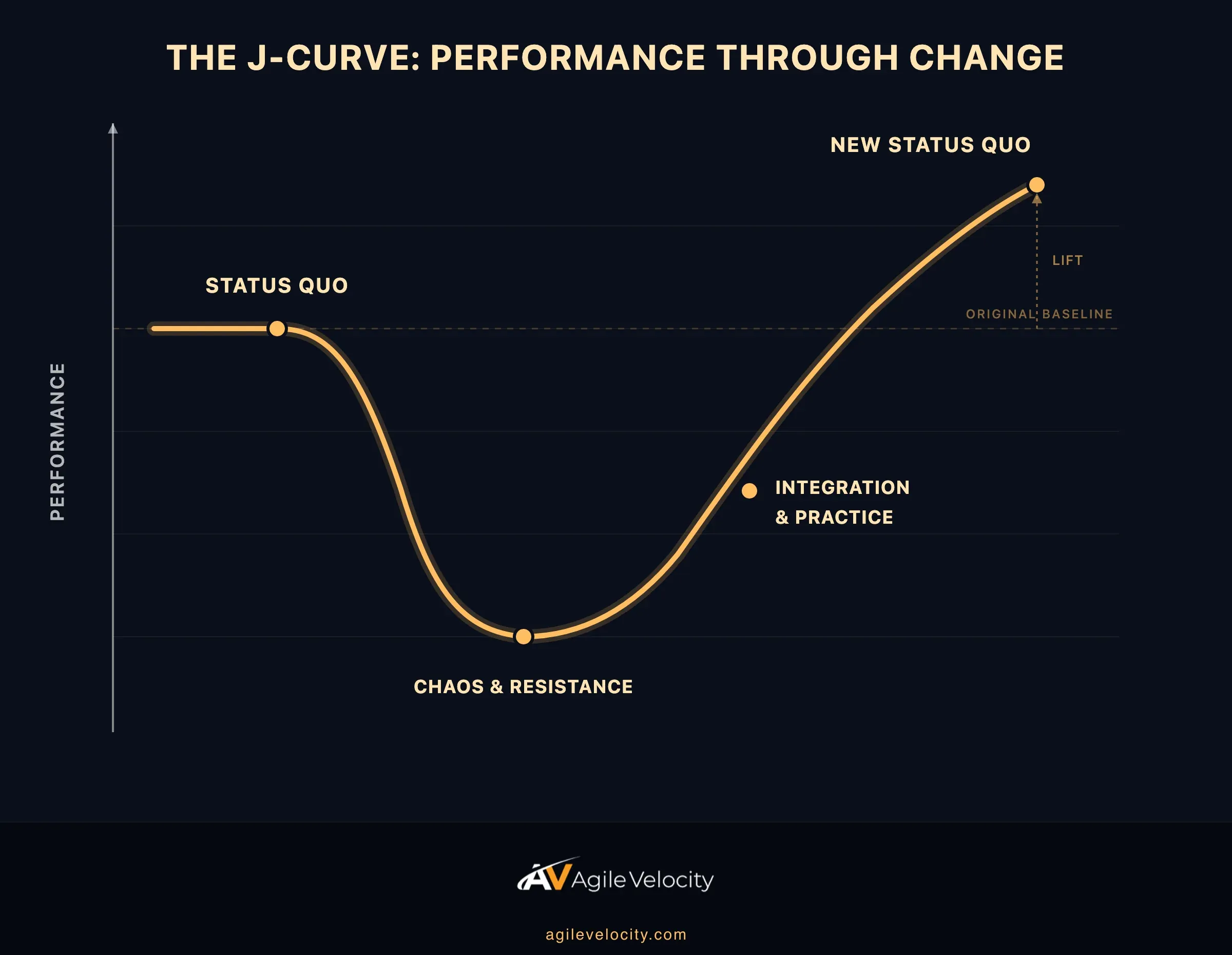
Every agile transformation produces a performance dip before producing gains. Teams restructure. New practices feel slower. Throughput drops temporarily. The Satir Change Model (the J-Curve) describes this as the "chaos" phase between status quo and the new status quo.
The executive decision is whether to hold the line through the dip. Most stalled transformations were abandoned inside the dip. Leadership saw throughput fall, blamed the methodology, and reintroduced the old controls that caused the original problems. Six months later they restart, and hit the same dip again. This is the yo-yo transformation pattern.
Before the next transformation step, the executive team has to commit out loud: "We expect performance to dip for X quarters. We will not reintroduce the old controls during that period." That commitment has to be visible to middle management, because middle management is where the pressure to reintroduce the old controls comes from.
How to Diagnose an Executive-Level Stall in 10 Minutes
Answer these six questions honestly about your own organization. Three or more "no" answers mean your transformation is stalled at the executive level regardless of what team metrics say.
- Can every executive on your leadership team name the two to three Business Outcomes the transformation is supposed to produce?
- Does your portfolio re-plan at least quarterly, with real funding reallocation?
- Is there one leading indicator per outcome that an executive owns and reviews weekly?
- Can your transformation owner change the funding model or reorganize portfolios?
- Has your executive team made an explicit commitment to hold the line through the J-Curve dip?
- When team-level data contradicts executive preferences, does the data win the conversation?
A low score does not mean your transformation is doomed. It means the work to unstick it is in the executive tier, not below it.
Frequently Asked Questions
How long should an agile transformation take before results show?
Expect early leading-indicator improvements in three to six months: cycle time on priority work, transparency on commitment rates. Business Outcome shifts typically take 12 to 18 months at enterprise scale. If a transformation is in month nine with no movement on any leading indicator, the cause is almost always an unresolved issue at the executive tier: undefined outcomes, unchanged funding model, or an abandoned commitment to the J-Curve.
What is the difference between a stalled transformation and a failed one?
A stalled transformation still has organizational energy and team-level practice. It has lost executive decision-making. That is recoverable without restarting. A failed transformation has lost both: teams have reverted to prior behavior and leadership has stopped defending the initiative publicly. Recovery from a failure requires a reset; recovery from a stall requires the four moves above.
Can we restart a stalled transformation without starting over?
Yes, in most cases. Restart at the executive tier by completing Move 1 (defining Business Outcomes) and assigning ownership. Then work down into Move 2 and Move 3. Team-level practices usually come back faster than expected once leadership decisions return. What does not work is announcing a restart without changing the executive behaviors that caused the stall.
Does the CEO or the COO own agile transformation success?
The CEO owns the outcome. The COO or equivalent owns the operating-model changes that enable the outcome. When those roles are confused, or both are delegated down, the transformation loses its top-level sponsor and stalls. The CEO does not need to run daily standups; the CEO does need to defend the J-Curve commitment when quarterly pressure tests it.
Does organization size change these four moves?
Not meaningfully. The symptoms look the same in a 200-person organization and a 20,000-person organization. The mechanics differ (portfolio cadence at enterprise scale is a larger operational lift), but the executive behaviors are identical. Smaller organizations often stall faster because there are fewer layers to hide behind.
From Stall to Traction
The research is consistent: the gap between the 48% of organizations that hit outcome targets and the 71% that do is not a framework gap, a tooling gap, or a team-maturity gap. It is an executive-behavior gap. Frameworks help. Tools help. Coaches help. But none of them substitute for executive decisions about outcomes, funding, cadence, and the J-Curve.
If the diagnostic above identified a stall in your organization, the unlock is not more coaching at the team level. It is your executive team completing the four moves: starting with Business Outcomes, rebuilding the portfolio cadence, owning leading indicators, and making an explicit J-Curve commitment. That is the work Path to Agility was built to support, and it is the work that differentiates the 71% cohort from the 48%.
Facing These Challenges First-Hand?
We've guided 100+ organizations through transformation. Let's talk about what's happening with yours.
Start a Conversation

