 Bhavani Krishnan
Stage-based agile maturity models tell you which practices teams adopted. They do not tell you whether teams can deliver the business outcomes leadership funded the transformation to produce. That gap wrecks budgets, stalls boards, and forces leaders to defend a transformation that looks healthy on a checklist while results sit flat. A capability-based maturity model closes the gap by tying every measurement back to a defined business outcome, so a "score" means something a CFO can act on. The Path to Agility® approach is one example of a capability-based model used in enterprise transformations.
Key Takeaways
- Stage-based models measure activity, not outcomes. Crawl-Walk-Run, CMMI-derived, "Initial → Optimizing" all score practice adoption. They do not predict whether speed, quality, or predictability will move.
- Capability-based models score the ability that drives outcomes. Teams are measured against the specific capabilities each business outcome depends on, then mapped to the outcomes leadership cares about.
- The Path to Agility approach uses 9 Business Outcomes, 26 Agile Outcomes, 100 capabilities, and 400+ practices. Capability scores tell leaders which outcome is stuck and which two or three capabilities are blocking it.
- A 4-minute capability diagnostic surfaces root causes that practice surveys miss: leadership alignment, change-management readiness, and governance gaps that suppress capabilities even when the practices are in place.
- Capability scoring changes the leadership conversation. Instead of "are we doing agile," the question becomes "is agile producing the outcomes we paid for." That is the question a board actually wants answered.
What a Stage-Based Maturity Model Actually Measures
Stage-based models trace their lineage to CMMI, the Capability Maturity Model Integration work that came out of software process improvement in the 1990s. The agile derivatives keep the same structure. Levels are labeled "Initial," "Managed," "Defined," "Quantitatively Managed," "Optimizing," or marketing-friendlier versions like Crawl, Walk, Run, Fly. A team is scored by which practices it has adopted at each level.
A typical progression looks like this:
- Stage 1. Running daily syncs, holding retrospectives, working in sprints.
- Stage 2. Refining a backlog, estimating in points, demoing increments.
- Stage 3. Using flow metrics, automating tests, releasing on a defined cadence.
- Stage 4. Measuring system-level dependencies, doing technical excellence work.
- Stage 5. Continuous learning culture, adaptive planning, organizational learning.
The output is a label: "Your team is at Stage 3 of 5." Sometimes a radar chart. Sometimes a percentage adoption score. This is useful information for a coach. It is not the information a leader needs to defend the transformation budget.
Why Stage-Based Maturity Misleads Leaders
The model rewards practice adoption not outcome delivery
A team can run textbook daily syncs and still ship late. It can refine a backlog every sprint and still build the wrong thing. It can score "Stage 4" on paper while the business outcomes leadership funded the transformation to improve (speed, quality, predictability, employee engagement) sit unchanged. Stage-based scoring rewards the activity. It does not measure the result. The gap between adopted practice and unchanged outcome is the structural definition of agile theater.
The Organizational Health Check assessment landing page names this directly. Practice checklists, maturity ladders, and self-reported surveys share the same flaw: a team can score well on practice adoption while the underlying business outcomes flatline.
The model flattens organizational context
Most stage-based models assume one organization is comparable to another. A 50-person product company at "Stage 3" is not in the same place as a 5,000-person bank at "Stage 3." Their dependencies, their risk tolerance, and their change-management exposure are completely different. A maturity ladder that gives them the same label hides everything that decides whether the transformation will hold.
The model ignores change-management readiness
Stage-based scoring almost never includes leadership behavior, middle-manager alignment, or resistance pattern recognition as scored dimensions. Yet those are the variables that decide whether agile practices stick. A team at "Stage 3" inside an organization where senior leaders model the old behaviors will regress within two quarters. Stage-based models cannot see that. Capability-based models can.
What a Capability-Based Maturity Model Measures Instead
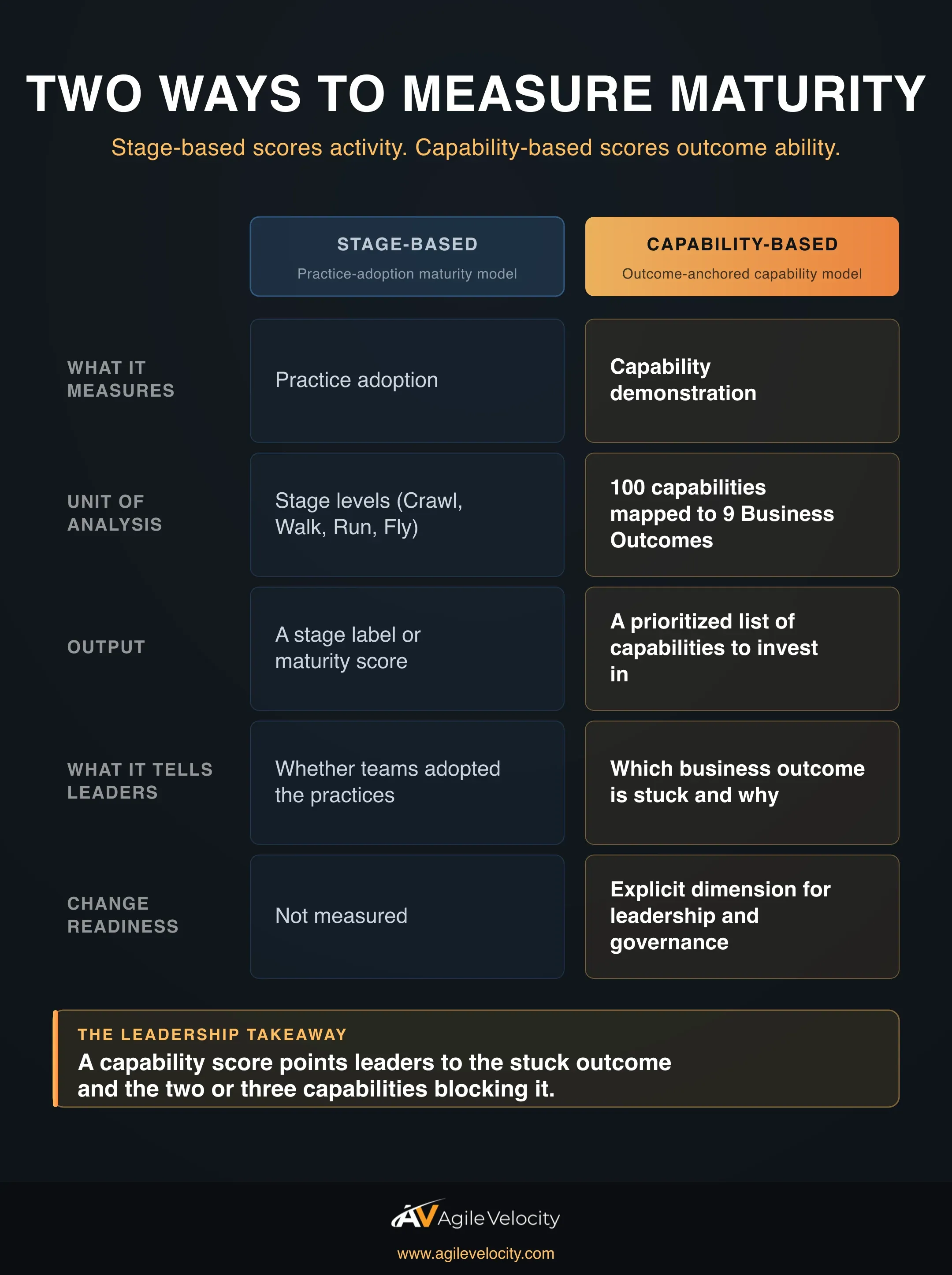
A capability-based model starts from the business outcome and works backward. Instead of asking "which practices is this team running," it asks "what does this team need to be able to do, what capabilities does it need to demonstrate, to produce the outcomes leadership funded the transformation to deliver?"
Path to Agility uses this structure:
- 9 Business Outcomes. The executive-level results the transformation is funded to produce: Speed, Quality, Predictability, Employee Engagement, Customer Satisfaction, Innovation, Market Responsiveness, Productivity, Continuous Improvement.
- 26 Agile Outcomes. The measurable improvements that drive the business outcomes, such as batch size reduction, dependency clarity, or release predictability.
- 100 Capabilities. The specific abilities teams and organizations need to demonstrate to deliver each outcome.
- 400+ Practices. The concrete actions that build each capability.
A team is not scored by which practices it has adopted. It is scored by which capabilities it can demonstrate, and how those capabilities trace back to the business outcomes leadership cares about. A leader can ask, "Speed is stuck. Which capabilities are we missing that drive Speed?" and get a specific, prioritized answer instead of a generic "do more daily syncs."
How to Run a Capability-Based Assessment
Four questions sit at the center of a capability-based assessment.
Which business outcomes are stuck?
Speed, Quality, Predictability, Employee Engagement, and the rest. Name the ones leadership expected to improve and rank them by current health. This is the anchor for everything that follows. A capability score that is not tied to a specific business outcome is just a checklist with extra steps.
Which capabilities drive each stuck outcome?
Each business outcome traces back to a specific subset of the 100 capabilities. Predictability traces to capabilities like flow management, dependency mapping, and forecast accuracy. Speed traces to capabilities like batch size discipline, deployment automation, and product clarity. Quality traces to capabilities like test automation, build feedback, and shared definition of done.
For each capability driving a stuck outcome does the team demonstrate it?
This is the scoring step. Not "did you do the practice last sprint" but "can your team consistently demonstrate this capability under pressure, when the schedule is tight, when leadership is watching, when something else is on fire." Capability is what survives stress. Practice is what survives a clean retrospective. A real continuous improvement culture is what closes the gap between them.
Where does change-management readiness break the chain?
Even when capabilities exist at the team level, leadership behavior or governance can suppress them. A capability-based assessment scores this explicitly. Six of the 18 questions in the Organizational Health Check, for example, ask whether senior leaders model the changes they request, whether middle managers equip or undermine teams, and whether resistance is treated as data or ignored. Practice surveys skip these entirely.
The output is not a stage label. It is a prioritized list of capabilities to invest in next, mapped to the specific business outcomes those capabilities will move.
What Capability Scores Tell Leaders
Three things stage-based scores cannot.
Where to invest next
Instead of "improve toward Stage 4," a capability score tells the leader exactly which two or three capabilities are blocking the most stuck outcome. Investment decisions become specific: sponsor a flow-management workshop for the platform team, hire a dedicated product manager into the data team, tighten governance on cross-team dependencies. Generic "do more agile" budget asks become outcome-anchored funding decisions.
Where to stop investing
Stage-based models tend to push organizations toward more practices indefinitely. Capability-based models will tell you when you have enough: when the capability is demonstrated, the outcome is moving, and adding another practice creates activity without business return. Knowing when to stop is what separates a finishable transformation from a permanent one.
Whether change management is the real bottleneck
When teams demonstrate the capabilities and outcomes still are not moving, the bottleneck is not the team. It is leadership behavior, governance, or culture. A capability-based assessment isolates that layer. Most stage-based assessments cannot. This is what an agile assessment can do to accelerate transformation: expose the layer that has to change next, with evidence the executive team will accept.
For the leading indicators that pair with capability scoring at the delivery level, see the companion piece on flow metrics for agile transformation leaders. Flow metrics tell leaders the system is slow. Capability scoring tells them why.
Facing These Challenges First-Hand?
We've guided 100+ organizations through transformation. Let's talk about what's happening with yours.
Start a ConversationHow Capability Scoring Connects to Path to Agility
The 9 Business Outcomes are the same outcomes Path to Agility scores against. The 26 Agile Outcomes are the measurable layer between executive intent and team capability. The 100 capabilities are what teams demonstrate. The 400+ practices are what coaches teach. The taxonomy is the working structure that lets a leader translate "the board wants faster delivery" into "we need to invest in dependency clarity and batch size discipline this quarter, in that order, because those are the two capabilities our current Speed score is bottlenecked on."
That translation is the actual job a capability-based maturity model does. Stage-based models cannot do it. The reason every top-ranking SERP result for "agile maturity assessment" is a stage-based template is not that stage-based models are right. It is that stage-based models are easier to publish as a downloadable checklist. They make a worse decision tool, but a tidier marketing artifact.
The Path to Agility approach walks through the full taxonomy if you want the structural detail before deciding whether to assess against it.
Frequently Asked Questions
Is a capability-based maturity model the same as an agile fluency model?
They share a philosophy: measure what teams can do, not which practices they run. They differ on granularity and outcome linkage. Agile fluency models cluster team behavior into a small number of zones (Focusing, Delivering, Optimizing, Strengthening). Capability-based models like Path to Agility break ability down into about 100 specific capabilities and map each to a defined Business Outcome. The capability layer is finer-grained, which is what leaders need when they are allocating budget against specific outcome gaps.
How is capability scoring different from DORA metrics?
DORA metrics measure delivery system performance: deployment frequency, lead time for changes, change failure rate, and time to restore. They are excellent leading indicators of delivery health. Capability scoring measures the underlying organizational ability that produces those numbers. DORA tells you the system is slow. Capability scoring tells you why, which is usually a combination of dependency management, batch size, governance, and product clarity capabilities. Use both. They answer different questions.
Can we score ourselves or do we need an outside assessor?
Self-scoring is useful for a quick directional read. The risk is that internal scorers grade against the practices they already run, rather than against an outcome-anchored definition of capability. An outside assessor, or a structured diagnostic anchored to business outcomes, corrects for that bias. Agile Velocity's Organizational Health Check is built for that purpose: 18 questions, 4 minutes, scored across the 9 Business Outcomes, with a dedicated change-management dimension.
How long should a capability-based assessment take?
A short diagnostic of 4 to 10 minutes can score directional capability against the 9 Business Outcomes and surface the top three gaps. A full assessment, including team-level interviews and capability scoring across all 100 capabilities, typically runs 4 to 8 weeks for a mid-size organization. The point of the short version is to identify which capabilities deserve a deeper read, not to skip the deeper read.
Why are most agile maturity assessments still stage-based?
Stage-based models are easier to package. A five-level ladder fits on a downloadable PDF and converts well as a lead magnet. The five top-ranking results for "agile maturity assessment" are all stage-based templates for that reason. The structure is a marketing convenience, not a measurement choice. A capability-based model is harder to publish as a checklist, which is exactly why it produces a more useful score for the leader who has to defend the transformation budget at the next board review.
Facing These Challenges First-Hand?
We've guided 100+ organizations through transformation. Let's talk about what's happening with yours.
Start a Conversation

