 Eric Cussen
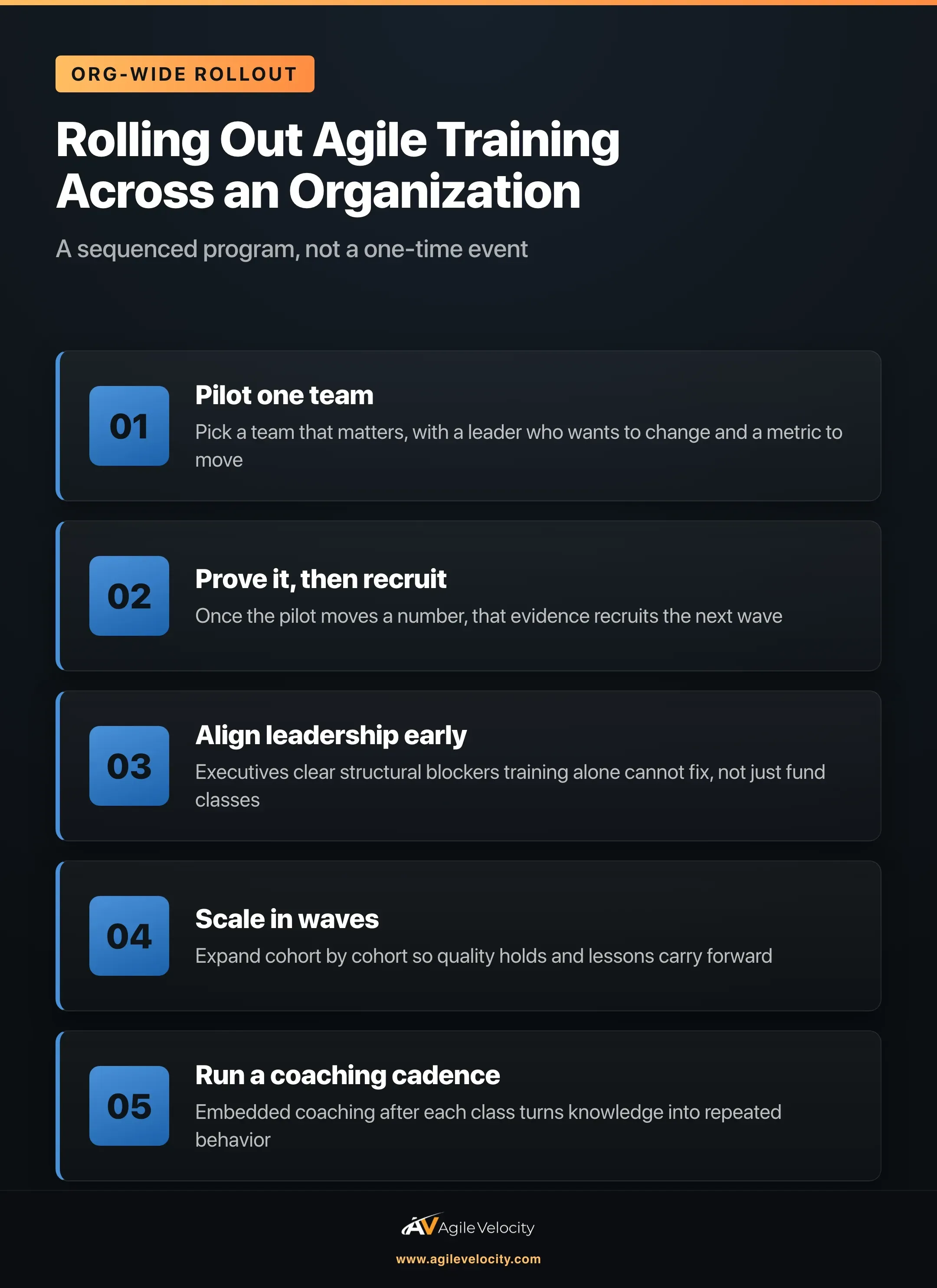
Scaling agile training across an organization is a sequenced program, not a one-time event. You run a small pilot, prove it moved a real number, remove the obstacles that pilot exposed, and only then expand to the next cohort. Roll-outs that skip this sequence, that book everyone into a two-day class and call it a transformation, almost always stall. The training was never the problem. The system around the training was.
If you are a transformation lead or an executive planning an organization-wide initiative, this is the roadmap: how to sequence the roll-out, what leadership actually has to do, how to connect the learning to business outcomes, and how to run a coaching cadence that makes the new skills stick.
Key Takeaways
- Roll out agile training as a sequenced program (pilot, prove, scale), not a single mass event, so each wave is informed by the last.
- Roughly 70 percent of large transformation programs fall short of their goals, and the largest share of that shortfall traces to leadership and people factors, not missing instruction.
- Leadership's job in a roll-out is to remove systemic obstacles (funding, structure, competing priorities), not just to fund the classes.
- Tie every course to a business outcome (speed, quality, predictability) so leaders can evaluate progress by results, not by badges issued.
- A steady coaching cadence after class (weekly for the first month, then monthly) turns knowledge into repeated behavior; training without follow-through fades in weeks.
Why do organization-wide agile training roll-outs stall?
Most roll-outs stall because the organization treats training as the transformation instead of an input to it. People leave the class energized, return to structures, incentives, and reporting lines that reward the old behavior, and revert within weeks.
The data backs this up. McKinsey's research on large-scale change has long found that roughly 70 percent of transformation programs fall short of their objectives. Those failures are multi-dimensional, but the largest contributing factors are consistently people and leadership related: inadequate management support and employee resistance, not a shortage of well-designed courses. In other words, organizations rarely stall for lack of training. They stall because the system around the newly trained teams never changed.
That reframes the whole exercise. A roll-out is not a procurement decision about how many seats to buy. It is a change program, and the training is one lever inside it. Treat it that way and the sequence below follows naturally.
Scaling agile training in sequence: pilot then prove then scale
Do not train everyone at once. Start with one team or one value stream, prove the approach works in your context, then expand in deliberate waves. Each wave should be smarter than the last because it is informed by real evidence, not a vendor's slide deck.
Start with a pilot that can actually be measured
Pick a single team or value stream that matters to the business and has a leader who wants to change. Before the first class, write down the one or two numbers you expect to move: cycle time, defect escape rate, release frequency, forecast accuracy. If you cannot name the number, you are not ready to pilot. A pilot without a baseline is just a class that a smaller group attended.
Keep the pilot small enough to observe closely and long enough to see behavior change, usually one to three months. The goal is not a perfect result. The goal is a credible, specific story you can carry to the next cohort and to the executives funding the roll-out.
Prove it then use the proof to recruit the next wave
Once the pilot moves a number, that evidence becomes your best recruiting tool. Other teams volunteer when they see peers delivering faster with less firefighting, and skeptical leaders fund the next wave when the pilot ties to a metric they already care about. Proof travels further than a mandate.
This is also where you decide what to standardize and what to leave flexible. Standardize the parts that create alignment (shared vocabulary, common events, a consistent way to measure progress). Leave room for teams to adapt practices to their context. For the broader mechanics of expanding across many teams at once, see our companion piece on scaling agile across multiple teams. This post stays focused on the training program itself.
Scale in waves instead of all at once
With a proven approach and internal advocates, expand cohort by cohort. Waves let you protect quality (your coaches are not spread thin), absorb lessons between groups, and keep leadership attention on a manageable slice of the organization at a time. A phased roll-out also gives you natural checkpoints to confirm the outcomes are still moving before you commit more budget.
What is leadership's role in an agile training roll-out?
Leadership's job is to remove the systemic obstacles that training alone cannot fix: misaligned funding, org structures that fight cross-team flow, competing priorities, and metrics that still reward the old behavior. Funding the classes is the easy part. Clearing the path is the real work.
A newly trained team that is told to self-organize, but still sits inside annual project budgets, hand-offs across five departments, and a bonus tied to utilization, will not stay agile no matter how good the course was. Those are executive-level constraints, and only executives can change them. This is why leadership alignment has to come early in the roll-out, not as a final formality.
Practically, that means executives commit to a small set of visible actions: sponsoring the outcomes publicly, clearing at least one structural blocker per wave, and reviewing progress on the business metrics rather than on attendance. Leaders who train alongside their teams, even briefly, send a signal that no memo can match. When we design a private program for an organization, the leadership component is deliberately built into the training for organizations engagement rather than bolted on afterward.
Connect the training to business outcomes
Tie every course to a business outcome the executives already track, so progress is evaluated by results rather than by certifications issued. A roll-out measured in badges tells you people attended. A roll-out measured in speed, quality, and predictability tells you whether anything actually changed.
This is the difference between a certification mill and a transformation. Certifications serve the individual and are useful, but a wall of certificates is not evidence that the organization delivers differently. The enterprise buyer is not trying to help fifty people pass an exam. The enterprise buyer is trying to ship faster with fewer surprises, and the training only matters if it moves those numbers.
This is the natural place to introduce a structured approach. Path to Agility® is the model we use to connect the practices teams learn in class to the outcomes leaders care about. Rather than starting from "which framework should we adopt," it works backward from the business outcomes you need, laddering 9 Business Outcomes to 26 Agile Outcomes to the specific capabilities and practices that move them. That gives a roll-out something most training programs lack: a way to show, capability by capability, how a class connects to a measurable business result. It also answers the leadership question directly, because progress is expressed in the same terms the executive team already uses to run the company.
To make the case for the investment before you scale, our training ROI calculator helps quantify the expected return of an org-wide program in terms leaders recognize.
Run a coaching cadence so the training sticks
Training creates awareness. A coaching cadence creates habit. Plan for regular, embedded coaching in the weeks after each class, because knowledge that is not practiced and reinforced fades fast, and the return-to-old-behavior gravity is strongest right after people go back to the floor.
A workable cadence looks like this:
- Immediately after class: a coach works alongside the team during their real events (planning, review, retrospective) rather than lecturing about them.
- Weekly for the first month: short, focused sessions on the specific obstacle that team is hitting right now.
- Monthly thereafter: lighter-touch reviews that confirm the new behavior is holding and surface systemic blockers to escalate to leadership.
The cadence is also your early-warning system. When a team keeps hitting the same wall, that is usually a structural obstacle only leadership can clear, and the coach is the person who spots it first. Embedded agile coaching is what converts a training event into a durable change in how the organization works, and it is the piece most self-serve, certification-first programs leave out entirely.
How do you measure progress across the roll-out?
Measure the roll-out on the business outcomes it was meant to improve, plus a small set of leading indicators that predict those outcomes. Avoid vanity metrics like seats filled or certifications earned; they measure activity, not change.
Track three layers together:
- Business outcomes (the point): delivery speed, quality, predictability, and whatever specific metric each wave committed to at the pilot stage.
- Leading indicators (early signal): cycle time, work-in-progress limits being respected, forecast accuracy, escaped defects. These move before the business outcomes do.
- Adoption signals (context, not the goal): are the new events actually happening, are teams using shared measures. Useful as diagnostics, never as the headline.
Report these on the same rhythm as your coaching cadence so leaders see the roll-out as a living program with a trajectory, not a training line item that closed when the last class ended. When the numbers move, you have your case for the next wave and, eventually, for the enterprise. For the full picture of how a company-wide program fits together, the enterprise agile training guide walks through the complete approach.
Frequently Asked Questions
How long does it take to roll out agile training across an organization?
Plan in waves rather than a fixed end date. A single pilot typically runs one to three months so you can see behavior change and measure a result. Scaling to the rest of the organization usually unfolds over several quarters to a year or more, depending on size and how quickly leadership clears structural obstacles between waves. The pace is set by proof and readiness, not by a training calendar.
Should we train everyone at the same time to save money?
No. Mass, simultaneous training is the most common reason roll-outs stall. Without a pilot to prove the approach in your context, you scale mistakes to the whole organization at once, spread your coaches too thin to make anything stick, and lose the evidence that recruits the next cohort. Sequenced waves cost less in wasted effort even when the per-seat price looks higher.
What is the difference between agile certifications and an agile training roll-out?
Certifications serve the individual and confirm that a person learned a body of knowledge. A roll-out changes how the organization works and is measured by business outcomes such as speed, quality, and predictability. Certifications can be part of a roll-out, but a stack of badges is not evidence that the organization delivers differently. The enterprise goal is changed behavior at scale, not credentials.
How do we keep skills from fading after the training ends?
Pair every class with an embedded coaching cadence. Coaches work alongside teams during their real events immediately after training, meet weekly through the first month, then shift to lighter monthly reviews. This turns classroom knowledge into repeated behavior and gives you an early-warning system for the structural obstacles only leadership can remove.
Facing These Challenges First-Hand?
We've guided 100+ organizations through transformation. Let's talk about what's happening with yours.
Start a ConversationRolling out agile training well is a sequencing and leadership problem more than a curriculum problem. If you are planning an organization-wide initiative and want a program built around your business outcomes rather than a fixed certification track, request a conversation about your roll-out.
Facing These Challenges First-Hand?
We've guided 100+ organizations through transformation. Let's talk about what's happening with yours.
Start a Conversation

