 Eric Cussen
If you have dozens or hundreds of engineers to upskill, do not scatter them across public classes one seat at a time and hope it adds up. Train whole teams together in private cohorts, sequence those cohorts across the organization on a deliberate schedule, and pair every cohort with a coaching layer that follows people back into their real work. Training starts the change. Coaching is what makes it stick. That combination is what effective agile training for large teams looks like, and it is how a large team actually adopts agile instead of collecting certificates.
The default approach fails for a specific, measurable reason: knowledge decays fast when it is not applied under real pressure. Without reinforcement, learners forget an average of roughly 90% of what they learned within about a month (the Ebbinghaus forgetting curve). A great two-day class that no one applies is a two-day class you paid for twice.
Key Takeaways
- Train whole teams together in private cohorts, not individuals in public seats, so the new language and practices take hold across the team at once.
- Sequence cohorts across teams on a schedule instead of training everyone at once; a wave-based roll-out protects delivery and lets early teams model the change.
- Without reinforcement, learners forget an average of about 90% of new material within a month, which is why training alone fades.
- Pair every cohort with coaching that follows the team into real delivery; coaching converts a class into changed behavior.
- Measure the roll-out by business outcomes like delivery speed and predictability, not by badge counts; roughly 70% of transformation efforts fall short of their objectives, and counting seats instead of capability is a common way to join them.
Why does per-seat public training break down at scale?
Public per-seat training breaks down at scale because it upskills individuals while leaving the team's actual way of working untouched. One engineer returns from a public class with new ideas and no authority to change how their team plans, estimates, or runs its events. The practices never take root.
Send fifty engineers to public classes over six months and you get fifty differently trained individuals, scheduled around whatever open dates existed, taught with generic examples that never touch your codebase or your delivery reality. There is no shared language, no shared moment, and no critical mass on any single team. Each person is outnumbered by teammates who were not in the room.
There is also a hard math problem. Public seats are priced per person and booked around a vendor's calendar, not yours. Upskilling a department this way is slow and expensive, and it leaves you with no way to sequence who learns what, when. For a VP of Engineering with a real headcount to move, the per-seat model is not a smaller version of the right answer. It is the wrong unit of change.
The right unit of change is the team.
What does agile training for large teams look like with the cohort model?
The cohort model trains an intact team, or several teams, together in a single private class built around your context, then repeats that class as a sequenced series across the organization. Everyone who works together learns together, at the same time, with examples drawn from your own work.
When a whole team learns in one room, the new vocabulary and practices become the team's shared default the moment they walk out. There is no lone advocate arguing against the group. The team decides together how it will plan, how it will run its events, and how it will measure flow, and it decides with the same information in everyone's head.
Private cohorts also let you tailor the material. Instead of a generic public agenda, the exercises use your systems, your dependencies, and your industry constraints, so the class is rehearsal for Monday rather than theory. Our private and enterprise training for organizations is built around intact teams for exactly this reason.
How do you sequence a roll-out across teams?
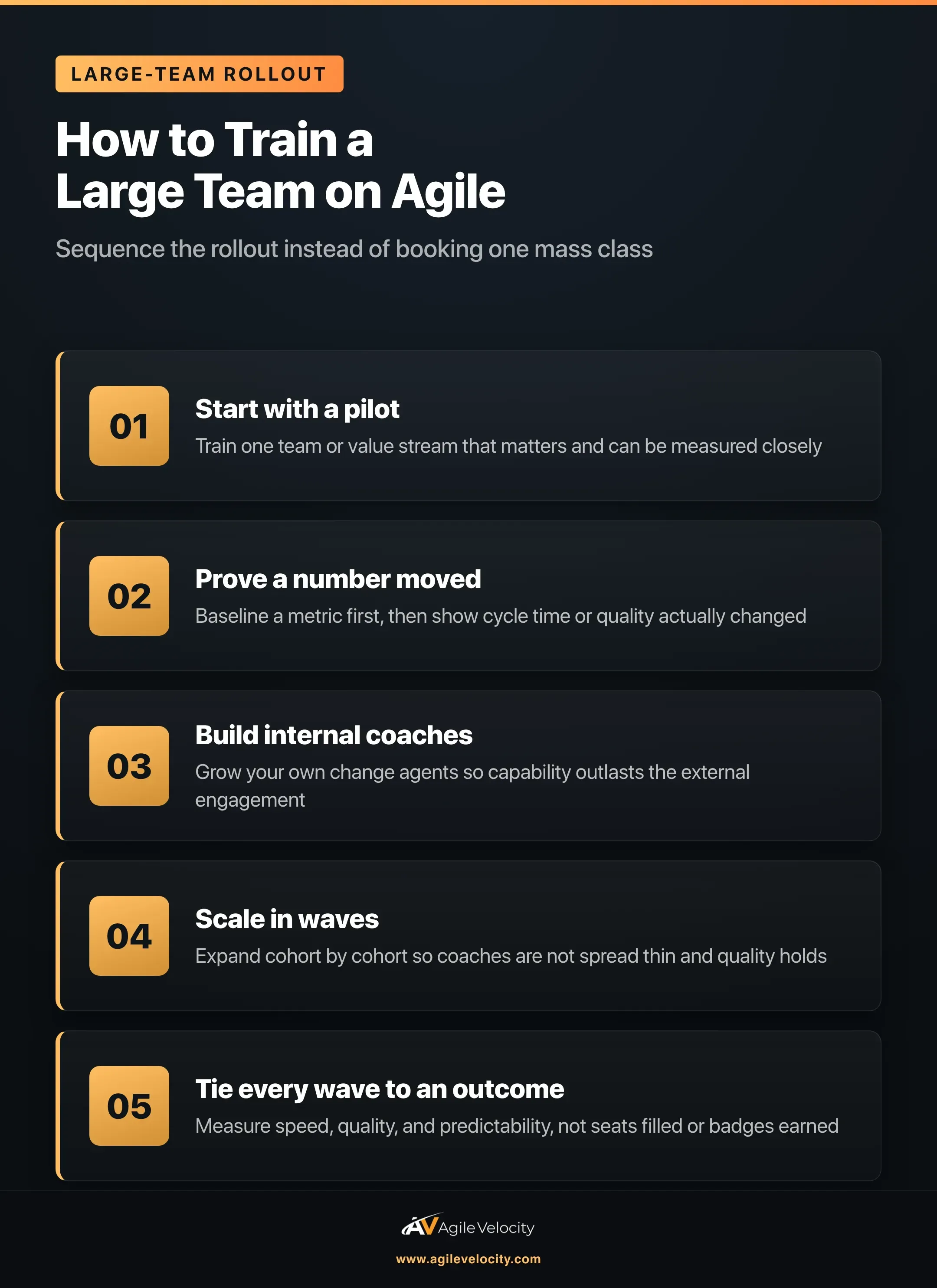
Sequence the roll-out in waves rather than training everyone at once. Pick a first wave of two or three teams, train and coach them to a working baseline, then use what you learn (and the teams you just built) to launch the next wave. This protects delivery capacity and creates internal proof.
A wave-based sequence gives you several advantages a big-bang training blitz cannot:
- Delivery keeps running. You never pull the entire engineering organization out of production at the same time.
- Early teams become the reference. Wave one gives later waves a working example inside your own walls, which beats any case study.
- You improve the program as you go. Each wave sharpens the examples, the sequence, and the coaching focus for the next.
- Leaders are sequenced too. Engineering managers and product leaders need their own cohort early, because teams cannot sustain new practices that their managers do not understand or reward.
A practical sequence for a large group looks like this: leadership and management alignment first, then a pilot wave of teams, then successive waves grouped by value stream or product area, with coaching running continuously underneath all of it.
What are the delivery options for distributed teams?
The three delivery options are in person, virtual, and hybrid, and the right choice depends on how your teams are distributed, not on a preference for one format. All three can carry the same cohort model and the same coaching follow-through.
- In person works best for a co-located team or a single site, where the energy of a shared room and hands-on facilitation is hard to beat, especially for the first alignment sessions.
- Virtual is the practical default for teams spread across cities or time zones. Live, instructor-led virtual cohorts keep the intact-team benefit without the travel cost, and they let you run more waves in parallel.
- Hybrid fits partly distributed teams: an in-person kickoff or leadership session to build momentum, followed by virtual cohorts and remote coaching for the rest of the roll-out.
For most enterprises with distributed engineering, a hybrid or fully virtual model is what makes a multi-wave sequence affordable and schedulable. The format is a logistics decision. The cohort structure and the coaching layer are what determine whether it works.
Why does training without coaching fade and how do you build the follow-through?
Training without coaching fades because a class transfers knowledge, and knowledge decays fast without application. Coaching is the reinforcement mechanism: it follows the team back into real delivery, helps them apply new practices under pressure, and adjusts as reality pushes back. Training starts the change; coaching is what makes it stick.
This is not a soft claim. The forgetting curve is well documented: without deliberate reinforcement, people lose the large majority of new material within weeks. Applied, socially reinforced learning retains far better than a one-and-done class. A cohort gives you the social reinforcement inside the room. Coaching gives you the applied reinforcement after it.
To build the follow-through, treat coaching as part of the roll-out from day one rather than a rescue you buy later:
- Attach a coach to each wave. The coach joins real planning sessions, retrospectives, and reviews, and helps the team practice what the class only introduced.
- Coach the leaders, not just the teams. Managers set the incentives. If they still reward the old behaviors, the new ones will not survive contact with a deadline.
- Grow internal capability. Good coaching leaves your own senior engineers and managers able to sustain the practices, so the organization is not dependent on outside help forever.
- Set a fade-out, not a cliff. Coaching intensity should taper as teams take ownership, ending when the team can hold the practices on its own.
Agile coaching is the layer that converts a well-run class into a changed operating rhythm. Without it, you have paid for knowledge that will be mostly gone by next quarter.
How should you measure whether the roll-out worked?
Measure the roll-out by business outcomes, not by badges. Certifications tell you an individual sat in a room. They tell you nothing about whether your teams ship faster, more predictably, or with fewer defects. Those outcomes are the point.
This is the core distinction in how we work. A certification serves the individual and follows them out the door if they leave. Changing how the organization delivers serves the business and stays. So track things that show the operating model actually moved: cycle time, delivery predictability against forecast, defect and rework rates, and how quickly teams can respond to a change in priorities. Roughly 70% of transformation efforts fall short of their objectives, and while those shortfalls are multi-dimensional, one of the most common patterns is confusing activity, like seats filled and courses completed, with capability. Do not measure the roll-out by how many people you trained. Measure it by how differently they work.
If you want to connect the spend to the return before you commit, our training ROI calculator helps you frame the numbers, and the enterprise agile training guide lays out the full picture of upskilling an organization at scale. The Path to Agility® approach exists to keep a roll-out anchored to those business outcomes, so training and coaching ladder up to speed, quality, and predictability rather than to a stack of certificates.
Frequently Asked Questions
How many people should be in an agile training cohort?
Keep a cohort close to the size of an intact team, usually 8 to 20 people, so everyone who works together learns together. For a large organization you run many cohorts of that size in sequenced waves rather than one enormous class. That keeps the discussion real and preserves the shared-language benefit that makes cohort training work.
Is certification worth it when training a large team?
Certification can be a useful byproduct, but it is the wrong goal for an enterprise roll-out. A badge serves the individual and leaves with them. What serves the business is a change in how teams plan, deliver, and improve, measured by outcomes like cycle time and predictability. Optimize the roll-out for changed behavior, not for the number of certificates issued.
How long does it take to train a large engineering team on agile?
Plan in waves over several months rather than a single event. A typical sequence trains and coaches a pilot wave of teams first, then rolls successive waves across value streams, with coaching running continuously. The classroom portion is short; the coaching follow-through that makes it stick runs for weeks to a few months per team before intensity tapers.
Can distributed teams get the same result as co-located ones?
Yes, if you keep the cohort intact and the coaching layer in place. Live, instructor-led virtual cohorts preserve the whole-team benefit for distributed groups, and remote coaching follows teams into their real work the same way in-person coaching does. The delivery format is a logistics choice; the cohort structure and coaching are what drive the result.
Facing These Challenges First-Hand?
We've guided 100+ organizations through transformation. Let's talk about what's happening with yours.
Start a ConversationReady to move a whole department, not a handful of individuals? Request a scope for your team roll-out and we will map the cohorts, the sequence, and the coaching layer to your headcount and your delivery reality.
Build Real Skills, Not Just Theory
29 certified courses across Scrum, SAFe, Kanban, and leadership, taught by practitioners who've led enterprise transformations.


