 Eric Cussen
Agile coaching vs training is the wrong way to frame the decision: they are not competing purchases. Training installs the knowledge and shared language your teams need in one to three focused days. Coaching embeds that knowledge into real work over the weeks and months that follow, when delivery pressure returns and old habits try to reassert themselves. If your last training investment faded, the problem was almost never the class. It was stopping at the class.
This is the pattern we see across enterprise transformations. Leaders buy a strong workshop, watch the energy spike, and then watch teams quietly revert to the way they worked before within a quarter. That is not a failure of the trainer or the team. It is a predictable consequence of treating knowledge transfer as if it were behavior change. They are different things, and they require different work.
Key Takeaways
- Training installs knowledge and shared language in one to three days. Coaching embeds new behavior into real delivery over weeks and months. You need both.
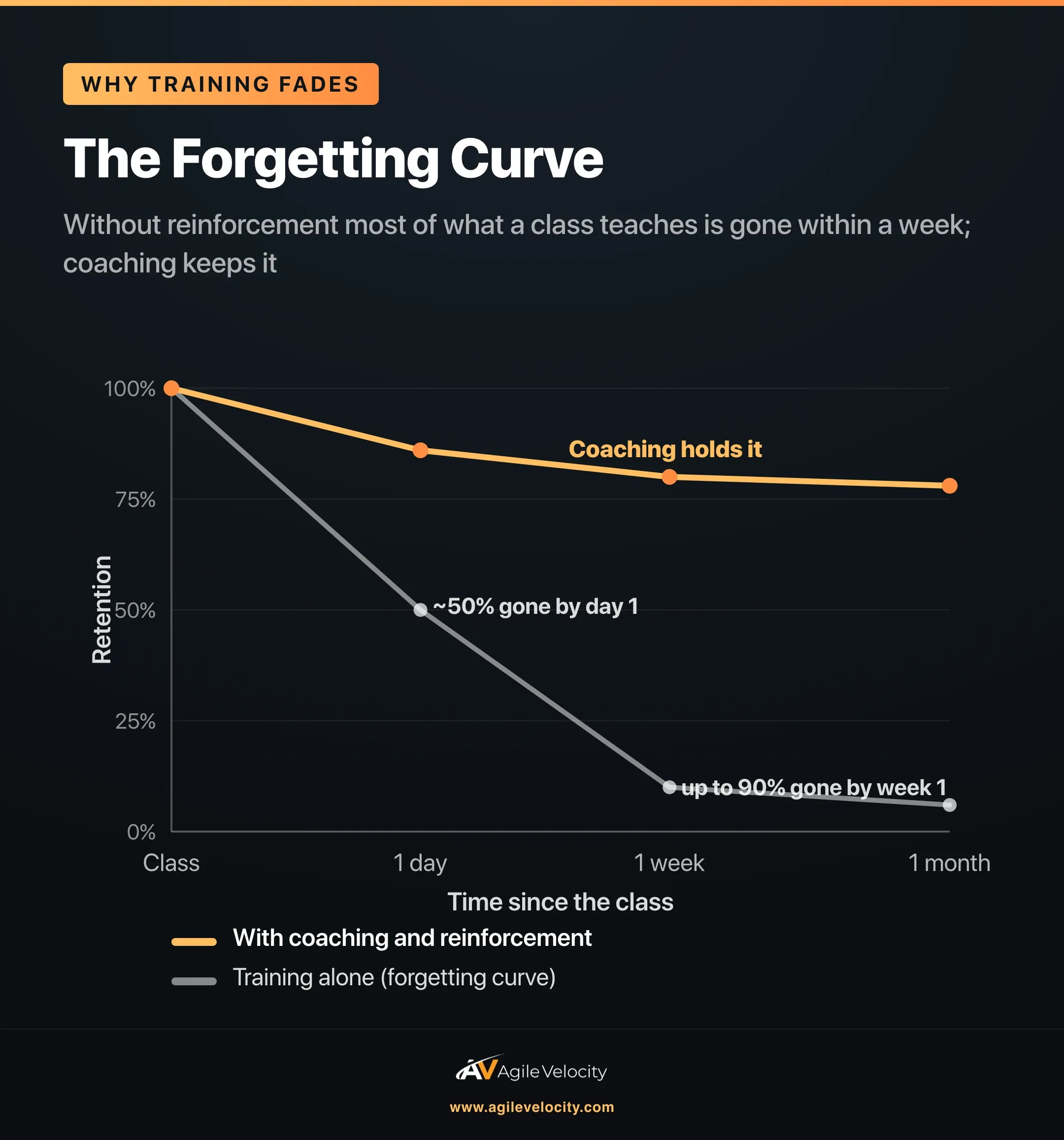
- Without reinforcement people forget roughly half of new material within a day and up to 90 percent within a week, per Ebbinghaus's forgetting curve.
- Training alone rarely changes behavior long term because old habits reassert the moment a deadline hits and there is no one in the room.
- Good coaching is delivered by practitioners, embedded in your actual work, and measured against business outcomes, not attendance or certificates.
- Start with training when teams lack shared vocabulary. Start with coaching when they know the theory but cannot apply it under pressure.
Agile coaching vs training: what is the difference?
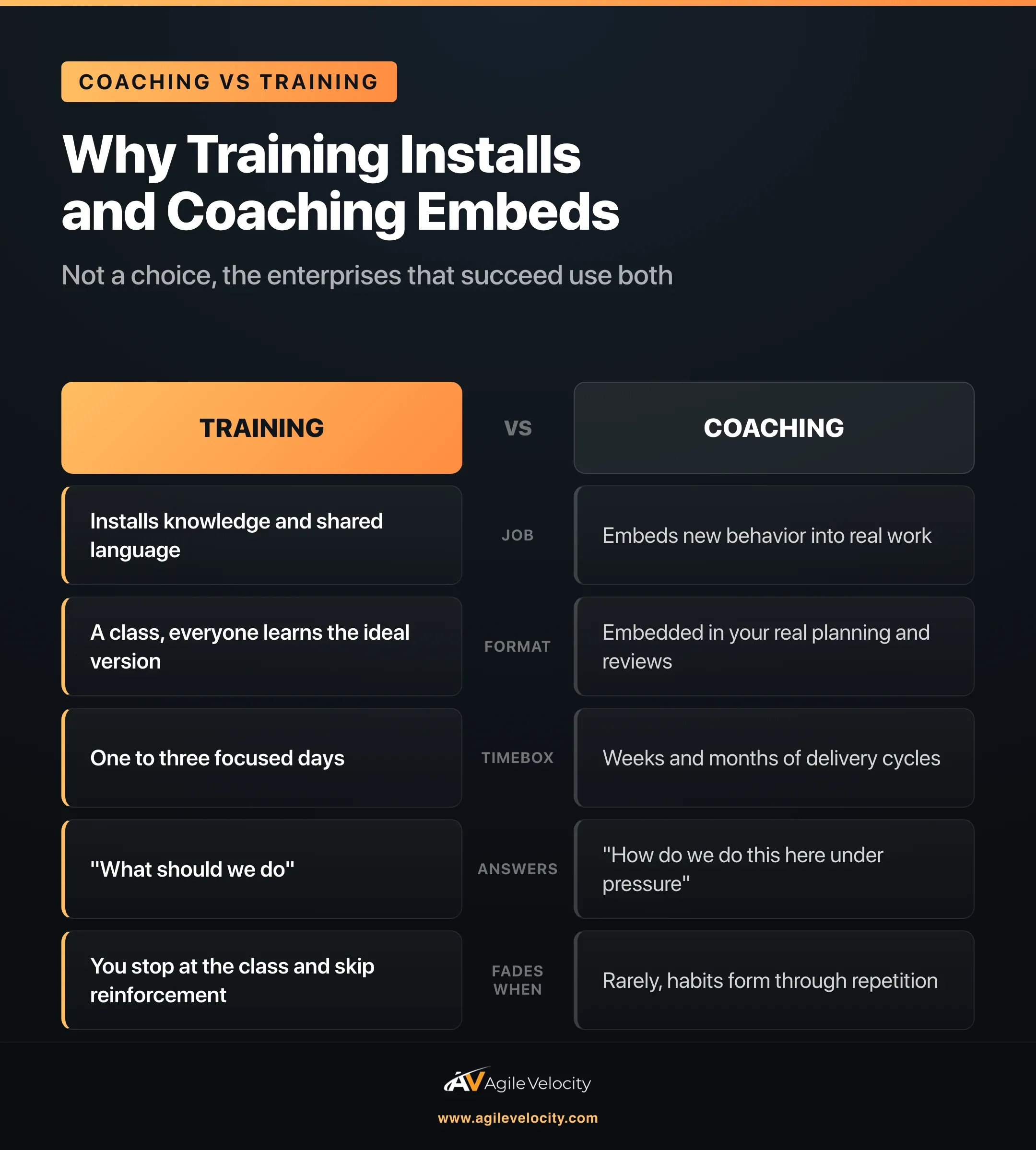
Training teaches a curriculum inside a fixed timebox, usually a workshop of one to three days. Coaching is embedded, ongoing guidance inside your team's real work over weeks or months. Training answers "what should we do." Coaching answers "how do we actually do this here, under our constraints."
Put simply, training is teaching and coaching is practice. A trainer stands at the front of a room and transfers a body of knowledge to a group: the mechanics of Scrum events, how to write a user story, what a definition of done is for, how flow works. That transfer is valuable and necessary. Everyone leaves speaking the same language, which is the precondition for changing anything.
A coach works differently. A coach sits with the team in their planning session, watches the retrospective actually happen, notices that the daily standup has quietly become a status report to the manager, and intervenes in the moment. Coaching is not a lecture about how retrospectives should work. It is helping this specific team run a better retrospective on Thursday, with these people, about this sprint. The learning happens in the doing, which is the only place behavior actually changes.
Training installs knowledge. Coaching embeds behavior.
Think of the two as sequential jobs rather than substitutes. Training installs the operating knowledge: the vocabulary, the models, the ideal version of how the work is supposed to flow. Coaching embeds that knowledge as habit by rehearsing it under real conditions until the new way becomes the default way. Knowledge that is never rehearsed in context does not survive contact with a deadline.
This is why the "vs" in agile coaching vs training is misleading. The high-performing enterprises we work with never choose one. They use training to create a common foundation quickly, then coaching to convert that foundation into changed behavior that holds when the pressure comes back.
Why does training alone rarely change behavior?
Training alone rarely sticks because memory decays fast and old habits are strong. Without reinforcement, people forget the majority of new material within days, and when a deadline hits they fall back on the behavior they already know rather than the behavior they learned last month in a classroom.
The memory problem is well documented. In the 1880s Hermann Ebbinghaus measured how quickly newly learned information fades and produced the forgetting curve: without deliberate reinforcement, retention drops steeply within the first day and keeps falling. His findings have held up under modern scrutiny. A 2015 replication published in PLOS ONE reproduced his original data closely, confirming that steep early decay is a real property of how human memory works, not an artifact of one nineteenth-century experiment.
Now layer that memory decay on top of organizational reality. A team returns from a two-day workshop energized. For a week or two the new practices hold. Then a major release date slips, an executive asks why a feature is late, and priorities scramble. Under that pressure the team does not reach for the practice they half-remember from a slide. They reach for the habit they have used for years, because habits are what the brain runs when it is stressed and there is no one there to prompt a different response.
The knowing-doing gap is where the investment leaks
The knowing-doing gap is the space between understanding a practice and being able to execute it under real pressure, and it is where most training investments quietly leak away. Training closes the knowing gap. It does almost nothing for the doing gap. There is a difference between knowing what a good sprint review looks like and being able to run one when your product owner is traveling, two stories are unfinished, and stakeholders are impatient. Most transformation budgets leak out through exactly this seam: the organization pays for knowledge, assumes behavior will follow, and never funds the reinforcement that turns one into the other.
None of this is an argument against training. Training is fast, efficient, and the right way to create shared understanding across many people at once. It is an argument against training as a complete solution. A class is the start of a change, not the change itself.
How do coaching and training work together?
Coaching and training work together in sequence. Training creates a shared foundation of knowledge quickly and cost-effectively across a group. Coaching then reinforces that knowledge inside real work until it becomes habit, adapting the ideal-world practices to the messy realities of your tooling, your priorities, and your org structure.
A workable pattern looks like this. Start with focused training to give everyone the same vocabulary and mental models. Then move coaches into the teams to work alongside them through several delivery cycles. The coach observes real events, spots where the textbook version breaks against your constraints, and helps the team adapt rather than abandon the practice. Over successive iterations the new behavior stops being something the team has to think about and becomes the way they work.
When should you start with training and when with coaching?
Start with training when your teams lack a shared foundation. If people are using the same words to mean different things, or have never been formally taught the mechanics, a classroom gets everyone aligned faster than anything else. Sequencing coaching before that foundation exists means the coach spends expensive embedded hours teaching basics that a workshop delivers in a fraction of the time.
Start with coaching when teams already know the theory but cannot make it work under real conditions. Plenty of organizations have been trained repeatedly. They can recite the Scrum Guide and still run standups that are status meetings and retrospectives that change nothing. More training will not help them. Embedded coaching that intervenes in their actual events is the only thing that moves that needle.
This is where a capability-based approach earns its keep. Path to Agility® is our model for exactly this sequencing decision. Rather than pushing every team through the same course, it looks at what an organization needs to be able to do, the capabilities that ladder up to measurable Agile Outcomes and ultimately to Business Outcomes such as speed, quality, and predictability, and then targets training and coaching at the specific gaps. That keeps the reinforcement work aimed at outcomes leaders can evaluate rather than at generic activity.
What does good agile coaching actually look like?
Good agile coaching is delivered by experienced practitioners, embedded in your team's real work rather than in a classroom, and measured against business outcomes rather than attendance or certificates. It adapts practices to your constraints, builds the team's own capability, and works itself out of a job as the behavior becomes self-sustaining.
Three characteristics separate coaching that changes an organization from coaching that just fills a calendar.
It is done by practitioners, not lecturers. A good coach has actually shipped software inside teams like yours and can earn credibility in the room because they have solved the problem the team is facing. They are not reading from the same deck they used for their certification. They know what to do when the ideal practice collides with a real constraint, because they have been in that collision before.
It is embedded in real work. Coaching happens in your planning session, your review, your refinement, not in a separate training room. The coach works with the actual sprint, the actual backlog, the actual stakeholders. That is the only place habits form, because habits are context-bound. A skill rehearsed in a classroom does not automatically transfer to the pressure of a live delivery cycle. A skill rehearsed in the live cycle does.
It is tied to outcomes. Good coaching is accountable to something a leader cares about: faster cycle time, more predictable delivery, higher quality, better engagement. It is not accountable to how many people attended or how many badges were earned. This is the sharpest line between a coaching engagement and a certification program. A certificate proves an individual sat in a class. It says nothing about whether the organization now delivers differently.
That distinction is the whole point of how we work. We are not a certification mill. Certifications serve the individual and their resume. Our job is to change how the organization operates, measured by business outcomes rather than a wall of badges. If you want to see how we structure that reinforcement, our agile coaching engagements are built to embed behavior, not just deliver content, and they sit alongside our broader training programs so leaders can sequence knowledge and practice deliberately rather than hoping a single workshop does both jobs.
Frequently Asked Questions
Is agile coaching better than agile training?
Neither is better. They do different jobs. Training installs knowledge and shared language quickly and cost-effectively across a group. Coaching embeds that knowledge as durable behavior inside real work. Training without coaching tends to fade once delivery pressure returns. Coaching without a knowledge foundation wastes expensive embedded hours teaching basics a workshop delivers faster. The enterprises that make agile stick sequence both.
Why did our agile training not stick?
Most likely because the organization stopped at the class and assumed knowledge would become behavior on its own. It rarely does. Without reinforcement, memory of new material decays within days, and under deadline pressure teams revert to the habits they already know. Training closes the knowing gap. It does little for the doing gap. Closing the doing gap requires coaching embedded in real work over multiple delivery cycles.
How long does an agile coaching engagement take to show results?
It varies with the size of the behavior change and the number of teams, but embedded coaching typically works across several delivery cycles rather than a single sprint, because habits form through repetition under real conditions. The goal is not indefinite dependency. Good coaching builds the team's own capability and works itself out of a job as the new behavior becomes self-sustaining, with progress measured against outcomes like cycle time and predictability.
Should we hire coaches or train our own people first?
Both, in sequence. Train broadly to create a shared foundation, then use experienced coaches to embed the behavior and, over time, develop internal coaches and change agents who can sustain it. Relying only on external coaches indefinitely is expensive and never transfers ownership. Relying only on internal people who have never been coached themselves usually reproduces the same habits you are trying to change.
Facing These Challenges First-Hand?
We've guided 100+ organizations through transformation. Let's talk about what's happening with yours.
Start a ConversationBuild Real Skills, Not Just Theory
29 certified courses across Scrum, SAFe, Kanban, and leadership, taught by practitioners who've led enterprise transformations.


