 Eric Cussen
If you are about to spend real money training your whole organization on agile, the honest answer to "why agile training fails" is this: the class almost never fails, the agile training rollout does. Companies send hundreds of people through two-day courses, collect the certificates, and six months later nothing about how work actually gets done has changed. The failure patterns are predictable, and every one of them is avoidable before you sign the contract.
This post names the five most common pitfalls in a company-wide agile training rollout, why each one happens, and how to avoid it. It is deliberately narrow. It covers the training decision specifically, not the whole transformation. If you want the broader set of failure modes, we cover those in our 10 agile transformation pitfalls series. Here we stay on the surface where most leaders waste the most money: the training rollout itself.
Key Takeaways
- McKinsey finds large-scale transformation efforts fail roughly 70% of the time, and a certificate-first training rollout is one of the most common early missteps.
- Training individuals instead of intact teams is the single biggest waste; capability lives in how a team works together, not in scattered badges.
- A two-day class with no coaching after it decays fast; the follow-through, not the workshop, is where behavior actually changes.
- If training is not tied to a business outcome you can measure, you cannot tell whether it worked, and neither can your CFO.
- Leaders who delegate agile to their teams and stay out of it signal that the change is optional, and the organization believes them.
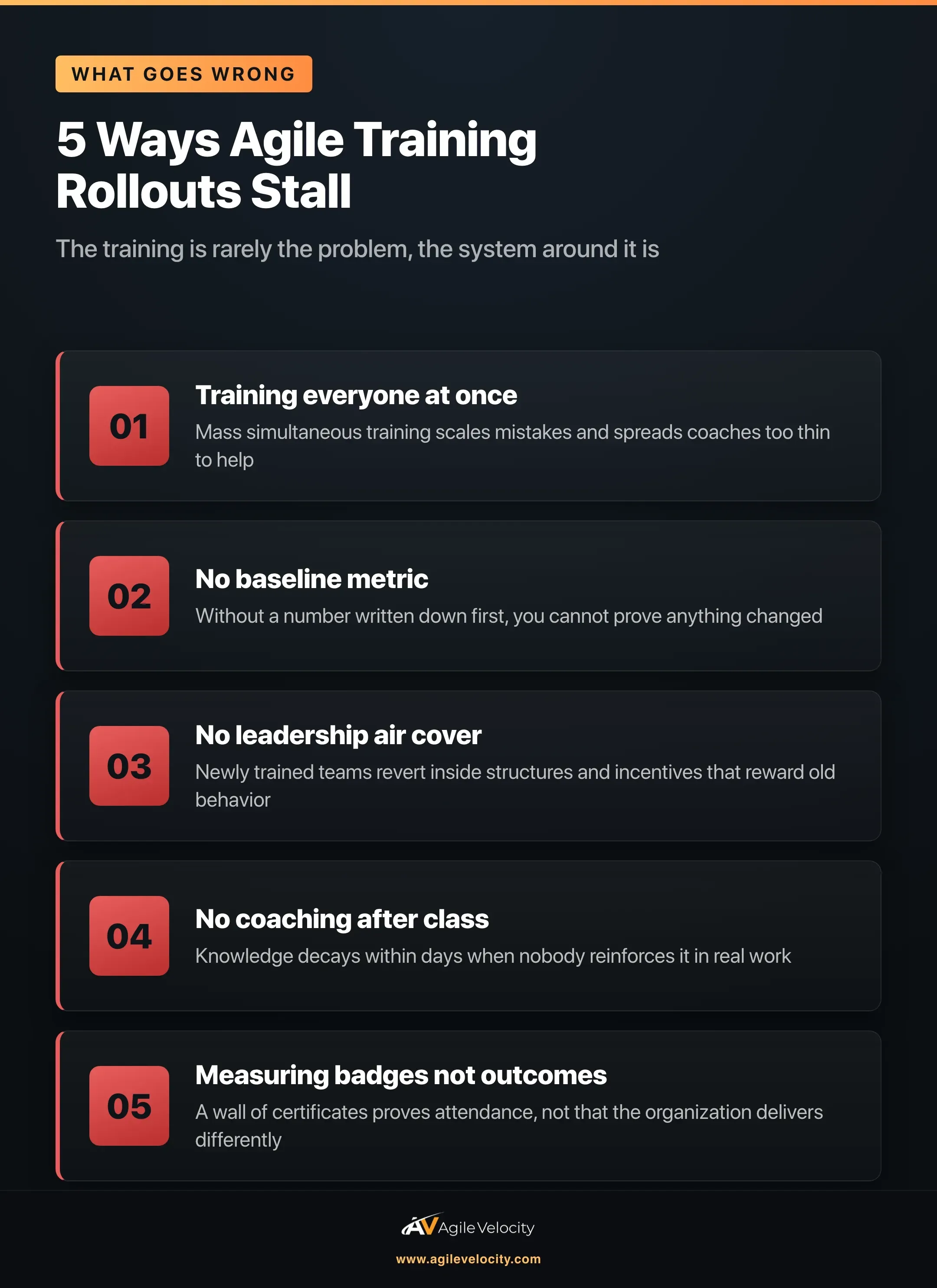
Why Does an Agile Training Rollout Fail So Often?
An agile training rollout is the company-wide program that puts teams and leaders through agile courses plus the coaching and measurement meant to change how work gets done. It fails when it is treated as an event that produces certified individuals rather than a capability change in how teams and leaders work. The class delivers knowledge to a room. Knowledge is not capability, and an individual is not a team. When the rollout stops at the certificate, nothing operational changes, and the spend shows up as cost with no return.
This is the distinction that matters for anyone doing due diligence. A certification serves the person who earns it. It is a line on a resume. Changing how your organization delivers value is a different problem, and it is measured differently: in delivery speed, quality, predictability, and the other business outcomes your leadership actually cares about. Path to Agility® exists precisely because most training markets stop at the badge and never touch the operating model. Keep that difference in front of you as you read the five pitfalls below, because every one of them is a version of confusing an event with a capability.
Pitfall 1: Training Individuals Instead of Teams
The fix in one line: Train intact teams together, in their real context, so the new way of working has somewhere to live.
Agile capability is a team property, not an individual one. A great sprint review, a useful retrospective, a refined backlog, a working definition of done, none of these exist inside one person. They exist in the working agreements and habits of a group. When you send individuals to open-enrollment classes and scatter them back across different teams, you have distributed knowledge and built zero capability.
Why it happens: Open-enrollment seats are easy to buy, easy to schedule, and easy to count. Procurement can process "120 certifications" cleanly. Training a real team on its real work is harder to package and harder to put on a spreadsheet, so the easier option wins by default.
How to avoid it: Insist that training is delivered to intact teams working on their actual product, not to a random mix of strangers. The workshop should use the team's real backlog, real dependencies, and real constraints. When the class ends, the team walks out with working agreements they built together, not a folder of generic slides. This is the difference between a course and a capability build, and it is worth asking any provider to explain exactly how they handle it. Our agile coaching model is built around teams for this reason.
Pitfall 2: No Coaching After the Class
The fix in one line: Budget for coaching after the workshop, because the workshop is where learning starts, not where behavior changes.
A two-day class can change what people know. It cannot, on its own, change what people do under pressure three weeks later when a deadline hits and the old habits are easier. The moment a team returns to daily delivery, the gravity of the previous way of working pulls hard. Without someone in the room to catch the backslide, reinforce the new events, and coach through the first hard sprints, the training decays quickly. Practitioner surveys repeatedly cite insufficient ongoing support, not weak course content, as a top reason agile efforts stall after a strong start.
Why it happens: Coaching is an ongoing cost, and it is tempting to treat the class as the finish line so the budget can close. A workshop has a clean start and end. Coaching is fuzzier and lasts longer, so it gets cut first when finance trims the line item.
How to avoid it: Treat the class as the opening move, not the deliverable. Plan for coaching to run alongside real delivery for the weeks and months after training, in the events themselves, with the team working on live problems. The ratio matters less than the presence: someone experienced watching the actual work and adjusting in real time. When you evaluate providers, ask what happens on day three, not just what happens in the class.
Pitfall 3: No Connection to a Business Outcome
The fix in one line: Tie the rollout to one or two measurable business outcomes before it starts, so you can prove whether it worked.
If your agile training is not connected to a specific business outcome, you have no way to know whether it succeeded, and neither does anyone approving the budget. "We trained 400 people" is an activity, not a result. Speed to market, delivery predictability, quality, employee engagement: these are the outcomes that justify the investment, and they are the only honest measure of whether the rollout changed anything.
Why it happens: Outcomes are harder to define than headcount, and they take longer to move. It is far simpler to report training completion than to commit, in advance, to a number that leadership will hold you to. So the rollout gets measured by attendance because attendance is easy.
How to avoid it: Start from the outcome and work backward. Decide before you train which one or two business outcomes this rollout is meant to move, agree how you will measure them, and take a baseline first. This is the core of the Path to Agility approach: capabilities ladder up to measurable agile outcomes, which ladder up to the business outcomes leaders evaluate. Working backward from the outcome also tells you which practices are worth training and which you can skip. If you want to put a dollar figure on it, our training ROI calculator is a useful place to start the conversation with finance.
Pitfall 4: Leaders Who Stay Out of It
The fix in one line: Put leaders through their own version of the change and hold them accountable for it, because the organization copies what leaders do, not what they announce.
When leadership sponsors agile training for everyone below them but exempts itself, the organization reads the signal instantly: this is something the teams have to do, not something we are actually changing. Leaders who keep annual fixed-scope planning, keep funding projects instead of products, and keep asking for firm commitments on dates and scope have not changed the system the teams operate inside. The teams then get blamed for failing to be agile inside a structure that punishes agility.
Why it happens: It is more comfortable to frame agile as a team-level skills gap than as a leadership and operating-model change. Delegating the training down is easier than examining how the top of the organization plans, funds, and governs the work.
How to avoid it: Involve leaders directly and early, in their own working sessions, focused on how they plan, fund, and govern, not on how teams run a standup. Make a named executive accountable for the business outcome the rollout is meant to move. Leadership participation is one of the most reliable predictors of whether a transformation sticks, which is why leaders staying on the sidelines shows up so often in the post-mortems of failed rollouts.
Pitfall 5: Treating the Framework as the Goal
The fix in one line: Treat Scrum, Kanban, or SAFe as a means to a better way of working, not as the destination you are training toward.
A delivery framework is a tool, not an outcome. When "roll out Scrum" or "adopt SAFe" becomes the goal, teams optimize for doing the framework correctly rather than for delivering value better. You get flawless standups, perfectly groomed backlogs, and immaculate boards, alongside the same slow delivery and the same unhappy customers you had before. This is agile theater: the events performed on schedule with none of the underlying change in how decisions get made or value gets delivered.
Why it happens: A framework is concrete and easy to train. "Are we doing the events correctly?" is a much easier question to answer than "are we delivering value faster and with higher quality than we were?" So the framework becomes the scoreboard because it is legible, and the real outcomes quietly fall off the agenda.
How to avoid it: Anchor the training in capabilities and outcomes, and let the framework serve them. Scrum, Kanban, and SAFe are all legitimate delivery frameworks; the question is never which one your teams can recite, it is whether the way your organization works is measurably better because of it. Train the framework as one path to a capability, keep the business outcome as the goal, and you avoid the most seductive trap in the entire rollout.
How Do You Vet an Agile Training Provider?
Ask five questions, one for each pitfall: Do you train intact teams on their real work? What coaching happens after the class? How do we tie this to a business outcome? How are our leaders involved? And how do you keep the framework from becoming the point? A provider that answers these crisply is selling capability. A provider that answers "how many people do you want certified?" is selling badges.
That single filter separates a certification mill from a partner. The certification mill optimizes for seats filled and certificates issued, because that is what it sells. A transformation partner optimizes for whether your organization works differently afterward, measured against outcomes you agreed on up front. For the full playbook on running this well rather than avoiding the traps, read our enterprise agile training guide, the pillar that this post sits underneath. If you are building the plan for a specific organization, our training for organizations page walks through how a team-based rollout is structured.
Frequently Asked Questions
Why does agile training fail even when the course is good?
Because the course is rarely the problem. Agile training fails when a strong class is dropped into a rollout that trains scattered individuals instead of teams, provides no coaching afterward, ties to no measurable business outcome, and leaves leadership behavior unchanged. Great content cannot survive a broken rollout around it.
Is certifying our people enough to become agile?
No. A certification demonstrates that an individual absorbed a body of knowledge. Becoming agile is an organizational capability change measured in delivery speed, quality, and predictability. You can have a hundred certified people and an organization that still works exactly as it did before. Certificates count individuals; outcomes count capability.
How much coaching do we need after agile training?
Enough to carry teams through their first several delivery cycles under real pressure, which is where old habits reassert themselves. The exact ratio matters less than the presence of experienced coaching inside the actual events and live work for weeks after the class, not a single follow-up session months later.
Should leaders attend agile training too?
Yes, in their own format. Leaders do not need to learn how to run a standup, but they do need to change how they plan, fund, and govern the work, because that system is what teams operate inside. When leaders exempt themselves, the organization treats the whole change as optional.
How is this different from your agile transformation pitfalls series?
This post is narrower. It covers only the failure patterns specific to a company-wide training rollout, the decision most leaders make first and spend the most on early. The broader series covers governance, culture, structure, and the full set of transformation failure modes.
Facing These Challenges First-Hand?
We've guided 100+ organizations through transformation. Let's talk about what's happening with yours.
Start a ConversationFacing These Challenges First-Hand?
We've guided 100+ organizations through transformation. Let's talk about what's happening with yours.
Start a Conversation

