 Eric Cussen
Enterprise agile training is a private, customized program that develops an entire team or organization at once, delivered on-site or virtually to your people using your real work as the material. Instead of sending individuals to a public certification class, you train the whole group together so everyone leaves speaking the same language, running the same practices, and understanding how their work connects to business outcomes.
That distinction is the entire point. Certifications develop an individual and hand them a badge. Enterprise agile training changes how a group of people actually works together. If you are a VP of Engineering, a transformation lead, or an L&D leader trying to move a real team forward, that difference decides whether the investment sticks or evaporates the week after class ends.
Key Takeaways
- Enterprise agile training develops a whole team or organization at once, privately and customized, rather than certifying individuals one at a time.
- The goal is a shared operating model: common language, common practices, and a common understanding of how work ladders up to business outcomes.
- McKinsey found the average transformation succeeds only 31 percent of the time, and the failures are usually multi-dimensional, driven by organizational gaps far more than a shortage of individual certificates.
- Successful agile transformations raised customer satisfaction 10 to 30 points and operational performance 30 to 50 percent in McKinsey's cross-sector analysis.
- Private delivery starts with your actual context and tech stack, so people apply the practices to live work instead of textbook scenarios.
What is enterprise agile training?
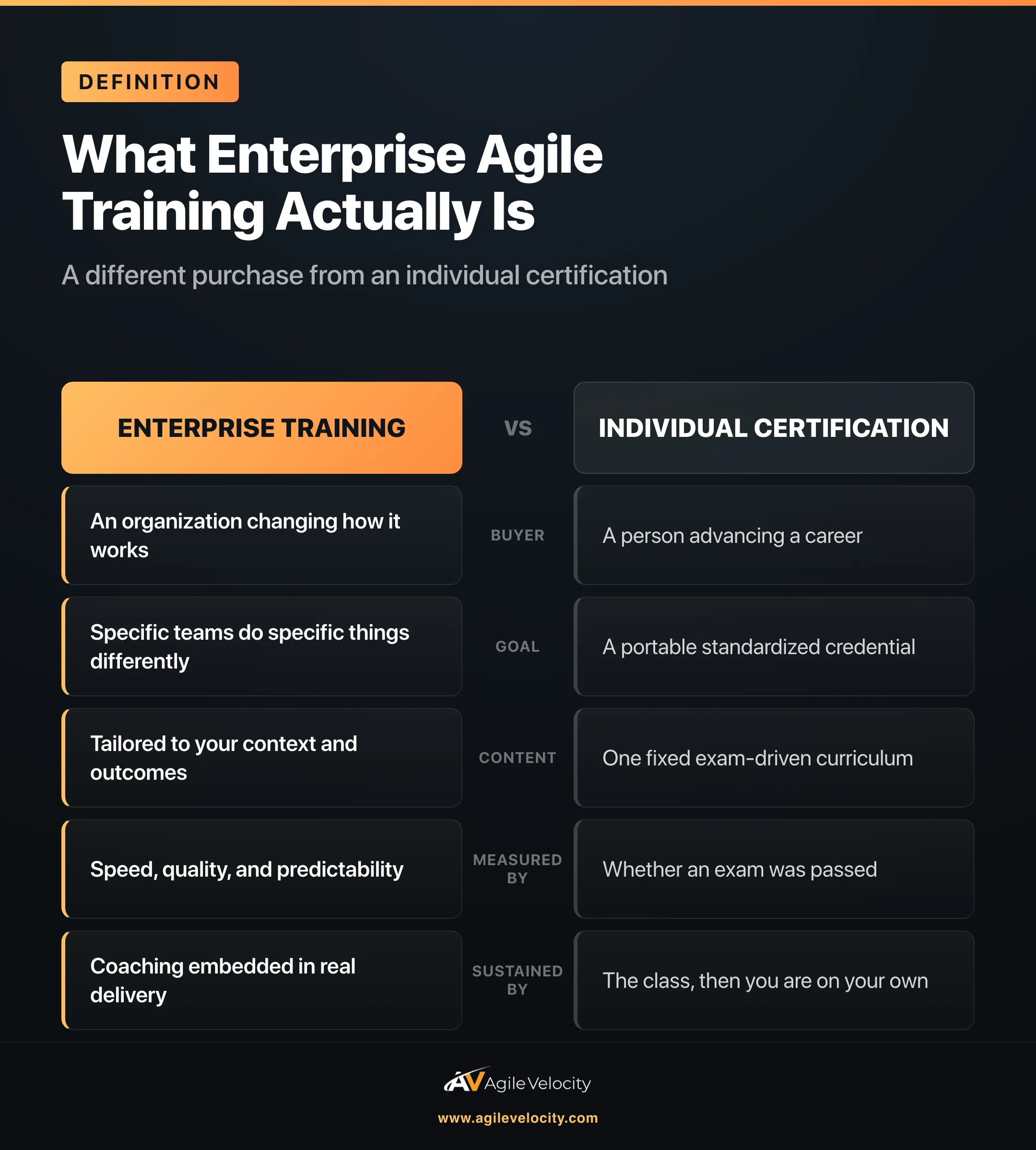
Enterprise agile training is agile education delivered privately to a defined group inside one organization, customized to that organization's context, and designed to build a shared way of working rather than a stack of individual credentials.
The word that matters most is "shared." A public class puts your Scrum Master in a room with 20 strangers from 20 companies, teaches a generic framework, and sends everyone home with a certificate. Nothing about their team changed. Enterprise agile training does the opposite: it takes your team, or several teams, and develops them together so the new practices become how the group operates, not trivia one person carries alone.
Delivery is tailored on three axes. The content is customized to your work and tech stack, so exercises use real backlogs and real constraints. The audience is your people, so the conversations surface your actual blockers instead of hypotheticals. And the outcome is measured against business goals your leadership already cares about, not against a passing exam score.
How is it different from sending individuals to certification classes?
The difference is scope and staying power. A certification class develops one person and gives them a credential. Enterprise agile training develops a whole team or organization at once, so the practices survive because everyone adopted them together.
Public certification has a place. It is a fine on-ramp for an individual building a resume. But for an organization trying to change how work gets done, the individual-certification model has a structural problem: you can certify a dozen people and still have zero teams working differently. The knowledge lives in scattered heads, gets diluted the moment it hits an unchanged environment, and rarely connects to any outcome a leader is measured on.
This is where our point of view is blunt: the industry has too many certification mills and too few organizations that actually work differently afterward. A badge serves the person. We care about changing how the organization delivers, and you cannot buy that one certificate at a time.
Who needs enterprise agile training?
Enterprise agile training fits organizations trying to change how multiple people or teams work together, not individuals seeking a personal credential. If you need a group aligned on the same practices at the same time, this is the model.
The clearest signals you need it rather than public classes:
- You have sent people to certification courses and seen no change in how teams actually deliver.
- Multiple teams need to coordinate and are using different flavors of agile that do not line up.
- Leadership wants transformation tied to measurable outcomes, not a training completion report.
- You are standing up a new operating model and need everyone adopting it in the same window, not trickling through public classes over 18 months.
If any of those describe your situation, the constraint is organizational, and the fix has to be organizational too. That is also why we frame this for the enterprise buyer. A private program for organizations solves a different problem than an individual's certification, and confusing the two is how transformation budgets get wasted.
How does private delivery work?
Private delivery starts with your context, not a fixed syllabus. A good provider assesses where your teams actually are, customizes the curriculum to your work, delivers it to your people together, and then measures the result against the outcomes leadership cares about.
In practice that means a short discovery to understand your current state and goals, a curriculum shaped around your real backlogs and constraints, hands-on sessions run for your intact teams (on-site or virtual), and role-specific tracks so product owners, Scrum Masters, engineers, and leaders each get what their role requires. The events your teams run, planning, reviews, retrospectives, and daily standups, become live practice grounds rather than slides. For a full walk-through of formats, roles, and how to scope a program, our complete enterprise agile training guide is the definitive resource, and this post is deliberately the short version of it.
How does enterprise agile training connect to business outcomes?
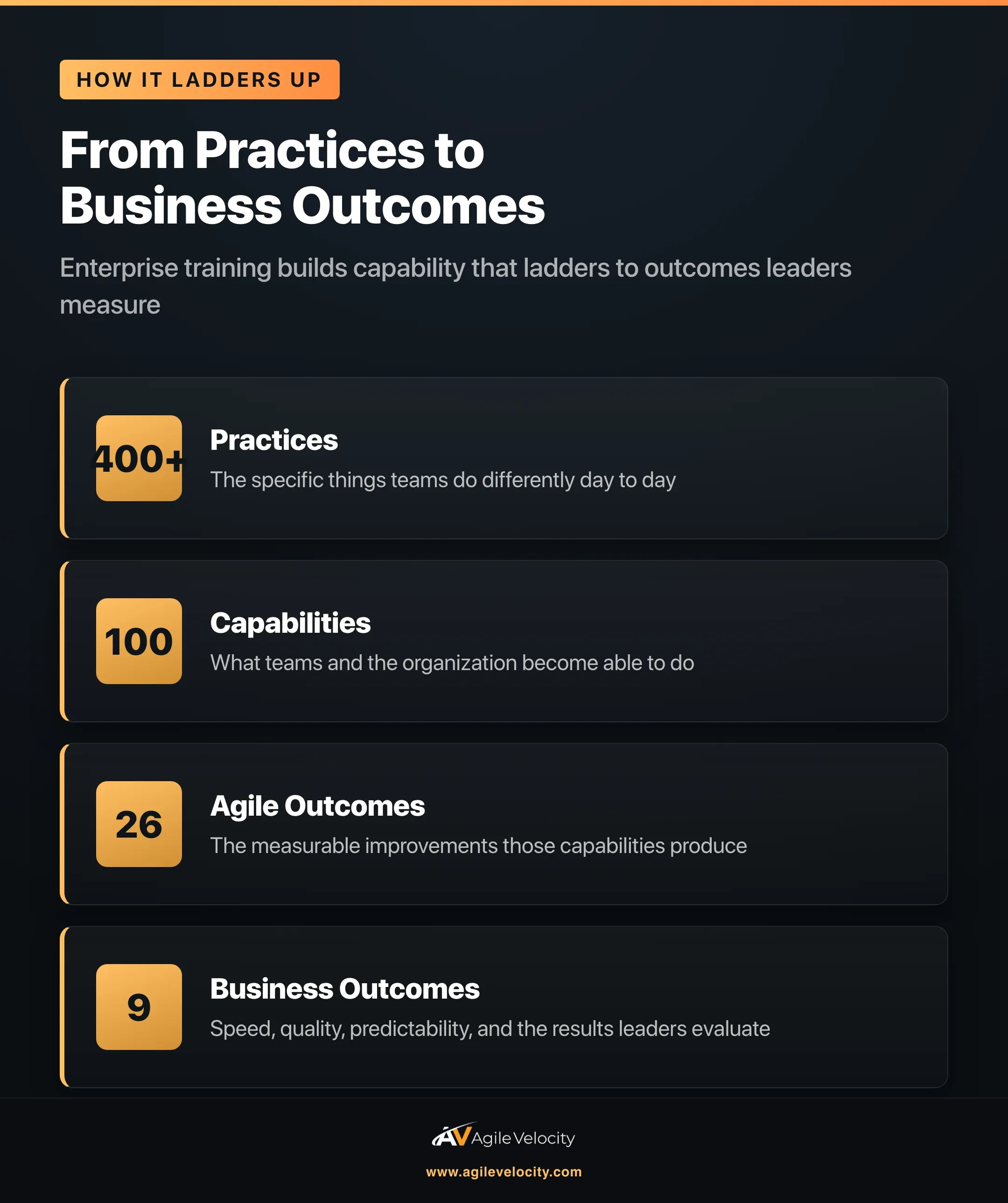
It connects by design: the training targets the capabilities that drive outcomes leaders already measure, then ties adoption back to those metrics. Certifications measure whether one person passed. Enterprise training measures whether the organization improved.
This matters because the odds are not in your favor by default. McKinsey found the average transformation succeeds only 31 percent of the time, and those failures are usually multi-dimensional. They stem from capability gaps, people-adoption gaps, and operating-model gaps far more than from any individual lacking a certificate, and enterprise agile training exists to close the shared-capability side of that equation.
When agile transformations do land, the payoff shows up in business terms. In McKinsey's cross-sector analysis of 22 organizations across six sectors, successful transformations raised customer satisfaction by 10 to 30 points, improved employee engagement by 20 to 30 points, and lifted operational performance by 30 to 50 percent. Those are outcomes a badge cannot produce, because they come from a group working differently, not from a certificate.
This is exactly the logic behind Path to Agility®, our outcome-driven model that connects the capabilities a team builds to the business results leadership is trying to move. Training is where those capabilities get installed. If you want to pressure-test the economics before committing, our training ROI calculator helps you frame the return in the same terms your leadership uses.
Frequently Asked Questions
Is enterprise agile training the same as agile certification?
No. Agile certification develops and credentials an individual, while enterprise agile training develops a whole team or organization at once. Certification proves one person learned a framework. Enterprise training changes how a group actually works together, measured by business outcomes rather than a passing badge.
Can enterprise agile training still include certification?
It can, but certification is a byproduct, not the goal. Some private programs award credentials alongside the training. The point of enterprise agile training is a shared way of working across your teams, so any certificates are secondary to whether the group actually operates differently afterward.
How long does an enterprise agile training program take?
It depends on scope, from a few days for a single team to a phased program spanning months for a multi-team transformation. Because private delivery is customized, the timeline is built around your goals and current maturity rather than a fixed public-course schedule. The complete guide covers how to scope this.
Is enterprise agile training worth it compared to public classes?
For organizations trying to change how teams work, yes. Public classes are cost-effective for one individual, but they rarely move a team. Enterprise training costs more per engagement and returns far more, because the whole group adopts the practices together and the results connect to outcomes leadership measures.
The short version
Enterprise agile training is how an organization changes the way it works, not how an individual collects a credential. It is private, customized, delivered to your teams together, and measured against business outcomes rather than exam scores. If you have watched certifications pile up without teams actually working differently, that gap is the reason enterprise agile training exists.
For the full breakdown of formats, roles, scoping, and how to run a program end to end, read the complete enterprise agile training guide.
Facing These Challenges First-Hand?
We've guided 100+ organizations through transformation. Let's talk about what's happening with yours.
Start a ConversationBuild Real Skills, Not Just Theory
29 certified courses across Scrum, SAFe, Kanban, and leadership, taught by practitioners who've led enterprise transformations.


