 Eric Cussen
The choice between private and public agile training is not a debate about which is better. It is a question of which job you are trying to do. Public training is built to certify an individual. Private training is built to change how a team works. If you send one engineer to a public class, they earn a badge and come back to a team that never attended, so the new way of working has nowhere to take root. If you train the whole team together, everyone leaves with the same language and the same practices, and the change actually holds. That difference, retention, is the entire decision.
Key Takeaways
- Public agile training certifies an individual. Private training changes how a whole team works. Match the model to the job, not to a preference.
- Transfer-of-training research estimates 50% to 90% of what people learn is lost within a year without on-the-job reinforcement. A trained individual on an untrained team is the worst case for that loss.
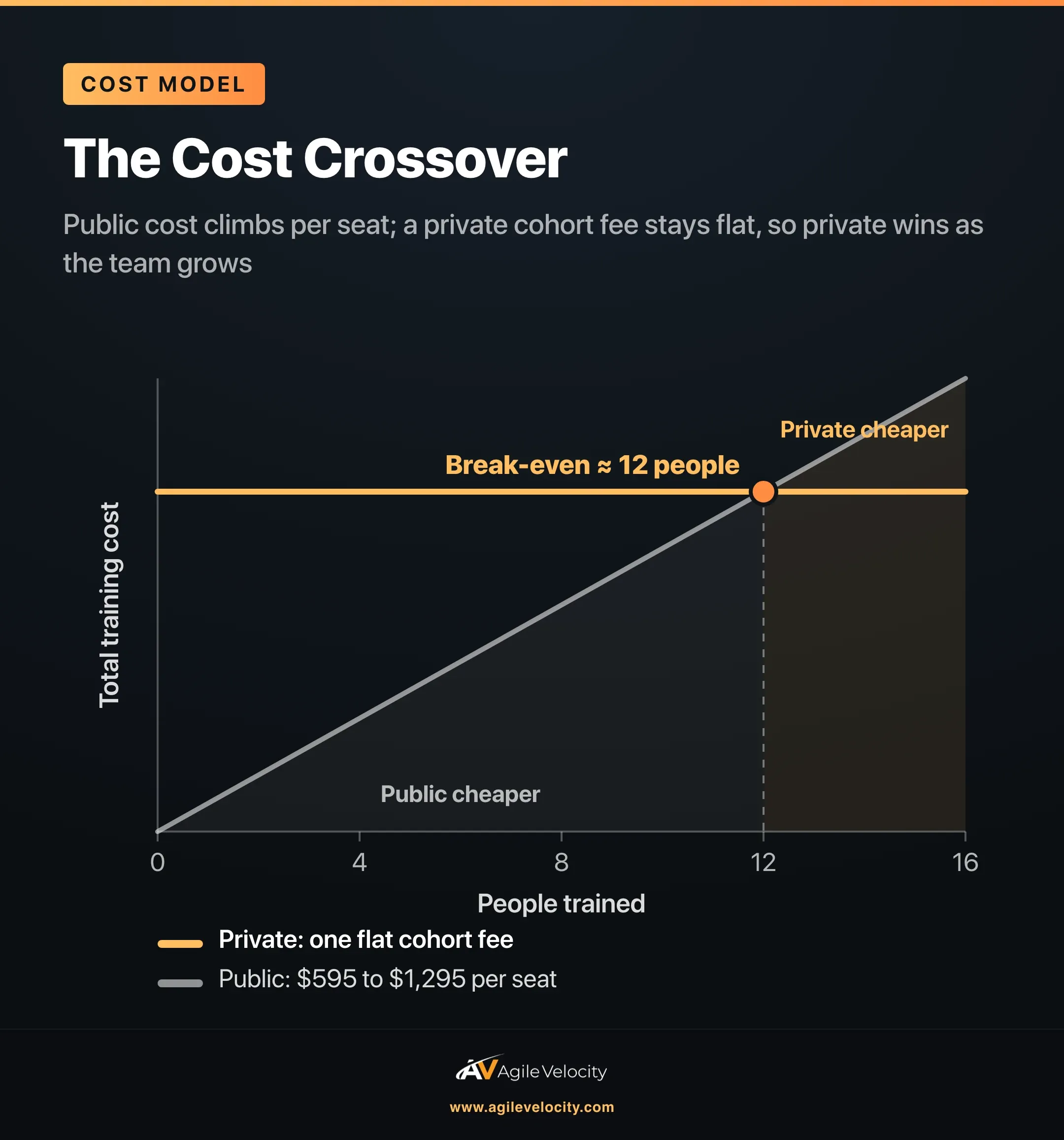
- Public courses run roughly $595 to $1,295 per seat, with a Certified ScrumMaster class near the lower end. Private training is one flat fee for the group and usually the better call at 12 or more people.
- Private training is customized to your actual work, tech stack, and events, so the practice sticks to the job instead of staying abstract.
- Public training is genuinely the right call for one or two individuals who need a credential or foundational coverage, not for a team trying to change how it operates.
What is the difference between private and public agile training?
Public agile training is an open-enrollment course you buy per seat, where individuals from many companies attend the same class to learn a framework and often earn a certification. Private training is delivered to your team only, priced as one flat fee for the group, and customized to your work, your tech stack, and your goals.
The distinction sounds like a scheduling detail. It is not. It changes what the training can accomplish. A public course teaches a person a body of knowledge. A private engagement teaches a team a new way of operating together. Those are different outcomes, and confusing them is how L&D budgets get spent on certificates that never change delivery.
At Agile Velocity, our position is deliberate. We are the anti-certification-mill. A badge serves the individual who carries it. We exist to change how the organization works, and we measure that change by business outcomes, not by how many people passed a two-day exam.
Private vs public agile training side by side
Public training optimizes for the individual buying a credential. Private training optimizes for the team changing how it works. Here is the comparison L&D leaders and VPs actually need when deciding how to spend a training budget.
| Dimension | Public (open enrollment) | Private (team or cohort) |
|---|---|---|
| Who it serves | An individual seeking a credential | A team changing how it works |
| Pricing model | Per seat | One flat fee for the group |
| Cost efficiency | Best for 1 to 2 people | Best at 12 or more people |
| Content | Standardized curriculum | Customized to your work and stack |
| Examples used | Generic case studies | Your real backlog, events, and constraints |
| Shared language | Only the attendee gains it | The whole team gains it together |
| Retention after class | Low; attendee returns to an untrained team | High; the team reinforces the change daily |
| Primary output | A certificate | A shared way of working |
| Best fit | Filling one skill gap | Shifting how a group delivers |
Read the table top to bottom and a pattern appears. Public training optimizes for the individual. Private training optimizes for the team. Neither is wrong. They are built for different jobs.
The cost model: per seat vs one flat fee
Public training charges per seat. A certification such as Certified ScrumMaster or CSPO commonly runs around $595 per seat, while advanced or scaled courses like SAFe run up to about $1,295. That math is fine for one or two people. It stops being fine fast.
Send twelve people to a public course and, even at the lower $595 per seat, you have spent over $7,000, plus travel, plus twelve people out of the office on potentially different dates. Private training inverts the economics. You pay one flat fee for the cohort, so the per-person cost falls as the group grows. Somewhere around twelve attendees the gap closes, and beyond that private is the clear winner on both cost and retention.
The economics are only half the story. The bigger return is that the flat-fee group all trains at the same time, on the same material, tuned to the same work. To see where the line falls for your specific team size and rates, run the numbers with our training ROI calculator before you commit a budget.
Customization and the retention argument
Customization is the reason private training retains and public training fades for a team. When a whole team learns on its own backlog, tech stack, and events, the new practices attach to daily work instead of staying abstract. This is the point that matters most, and it is the one public training cannot answer.
Why does a public class fade after people return?
Because the individual comes back to a team that did not attend. Transfer-of-training research estimates that 50% to 90% of what people learn is lost within a year without reinforcement, and one trained person surrounded by untrained colleagues has nothing to reinforce the new behavior. The old way wins by default.
Picture it concretely. Your Scrum Master goes to a public class, learns a cleaner way to run refinement and retrospectives, and returns energized. On Monday, the rest of the team is still working the old way. There is no shared vocabulary, no shared agreement on the new events, no peer pressure to change. Within a few sprints, the new practices quietly disappear and the certificate goes on a wall. The Association for Talent Development is widely cited for the finding that only about 12% of employees apply what they learn in training back on the job. A trained individual on an untrained team is close to the worst case for that number.
Private training attacks the problem at its source. When the whole team trains together, on your actual backlog, your actual tech stack, and your actual events, everyone leaves with the same language and the same expectations. The change is not one person's private knowledge. It is the team's shared operating agreement, reinforced every single day by everyone who was in the room. That is why private training retains and public training, for a team, usually does not.
This is also why transformation is not a training-alone problem. McKinsey found only about 31% of agile transformations were classified as highly successful, and those failures are usually multi-dimensional, spanning people adoption, capability, and operating-model gaps. Training a whole team together closes the people-adoption gap that a stack of individual certificates leaves wide open. It is the difference between certifying people and changing how the organization works, which is exactly what the Path to Agility® approach and our private and enterprise training for organizations are built to do.
When is public agile training genuinely the right choice?
When you need to train one or two individuals, not a team. If a single new hire needs foundational coverage, or one person needs a specific credential for a role or a client requirement, a public class is the faster and cheaper path. There is no team dynamic to change, so the retention problem does not apply.
Public training is the right tool when the job is filling an individual skill gap:
- A new manager who needs a grounding in agile basics before they lead
- One specialist who needs a specific certification for compliance or a contract
- A curious individual exploring whether a discipline fits their career
- A tiny group, two people, where a private engagement is not yet economical
The mistake is not choosing public. The mistake is choosing public for a job it was never built to do, which is changing how an entire team delivers. If more than a handful of people need to work differently together, public training will cost more and deliver less than the private alternative. For the full decision framework across roles, cohorts, and budgets, see our enterprise agile training guide.
How many people justify private agile training?
Around twelve. Below that, per-seat public pricing is usually competitive and a private cohort may be hard to justify on cost alone. At twelve or more, the cost gap narrows and private wins decisively on retention, because the whole group changes together instead of one person changing alone.
Use the headcount as a first filter, then weigh the second question that matters even more than cost: are you trying to certify people, or change how they work? If it is the latter, the answer is private almost regardless of the exact number, because only private training produces the shared language that makes a new way of working stick.
Frequently Asked Questions
Is private agile training more expensive than public?
Not for a team. Public training charges per seat, so a group of twelve can run over $7,000 plus travel, and more for premium courses. Private training is one flat fee for the whole group, which usually makes it the better value at around twelve people or more, and it delivers a shared way of working that per-seat training cannot.
Can public agile training change how my team works?
Rarely. Public training certifies the individual who attends, but they return to a team that did not, so there is no shared language or reinforcement. Transfer-of-training research estimates 50% to 90% of learning is lost within a year without reinforcement, and a lone trained person on an untrained team has none.
When should I choose public over private training?
Choose public when you need to train one or two individuals rather than a team. A new hire needing foundational coverage, or one person needing a specific credential for a role or contract, is a good fit. Once more than a handful of people need to work differently together, private is cheaper and far more effective.
How is private agile training customized?
Private training is tuned to your actual work. Instead of generic case studies, we use your real backlog, your tech stack, your delivery events, and your business goals, so the practice attaches to the job people do every day rather than staying abstract. That customization is a large part of why private training retains.
Does a certification mean my team is agile?
No. A certification confirms an individual passed a course. It does not confirm the team changed how it delivers. We measure success by business outcomes, speed, quality, and predictability, not by how many badges are on the wall. Changing how the organization works is the goal, and the Path to Agility approach is how we structure and measure that change.
Facing These Challenges First-Hand?
We've guided 100+ organizations through transformation. Let's talk about what's happening with yours.
Start a ConversationThe decision is not private versus public in the abstract. It is which job you are hiring the training to do. If you are certifying one person, buy a seat. If you are changing how a team delivers, train the team together. Run your numbers in the training ROI calculator to see where the cost line falls for your headcount, then request a private-training scope so we can tune it to your actual work.
Build Real Skills, Not Just Theory
29 certified courses across Scrum, SAFe, Kanban, and leadership, taught by practitioners who've led enterprise transformations.


