 Marc Story
To measure agile training effectiveness, stop counting attendance and satisfaction and start measuring behavior change and business outcomes: lead time, cycle time, delivery predictability, defect rates, and retention. Baseline those metrics before training, re-measure 60 to 90 days after, and attribute the delta to the behaviors the training was meant to change. Everything else is a vanity number.
Agile training effectiveness is the degree to which training changes how teams work and moves measurable business outcomes, not how many people attended or how highly they rated the class. Most agile training is evaluated on the two things easiest to collect and least worth knowing: how many people showed up and how happy they were when they left. Both feel like proof. Neither tells you whether the way your teams work actually changed. If you lead learning and development and you are being asked to defend a training budget, the questions coming at you are not "was the class good." They are "did delivery get faster, more predictable, and higher quality, and can you show it." This is how you answer that.
Key Takeaways
- Satisfaction scores and attendance measure reaction, not results. They are weak predictors of whether behavior on the job actually changed.
- The Kirkpatrick model defines four levels: Reaction, Learning, Behavior, and Results. Most organizations stop at Level 1. The value lives in Levels 3 and 4.
- Measure behavior change (leading indicators) and business outcomes (lagging indicators): lead time, cycle time, delivery predictability, defect rate, and retention.
- Baseline every metric before training and re-measure 60 to 90 days after. Without a before number, an after number proves nothing.
- A certification count is a Level 1 vanity metric. Changed organizational behavior measured against business outcomes is the only proof that survives scrutiny.
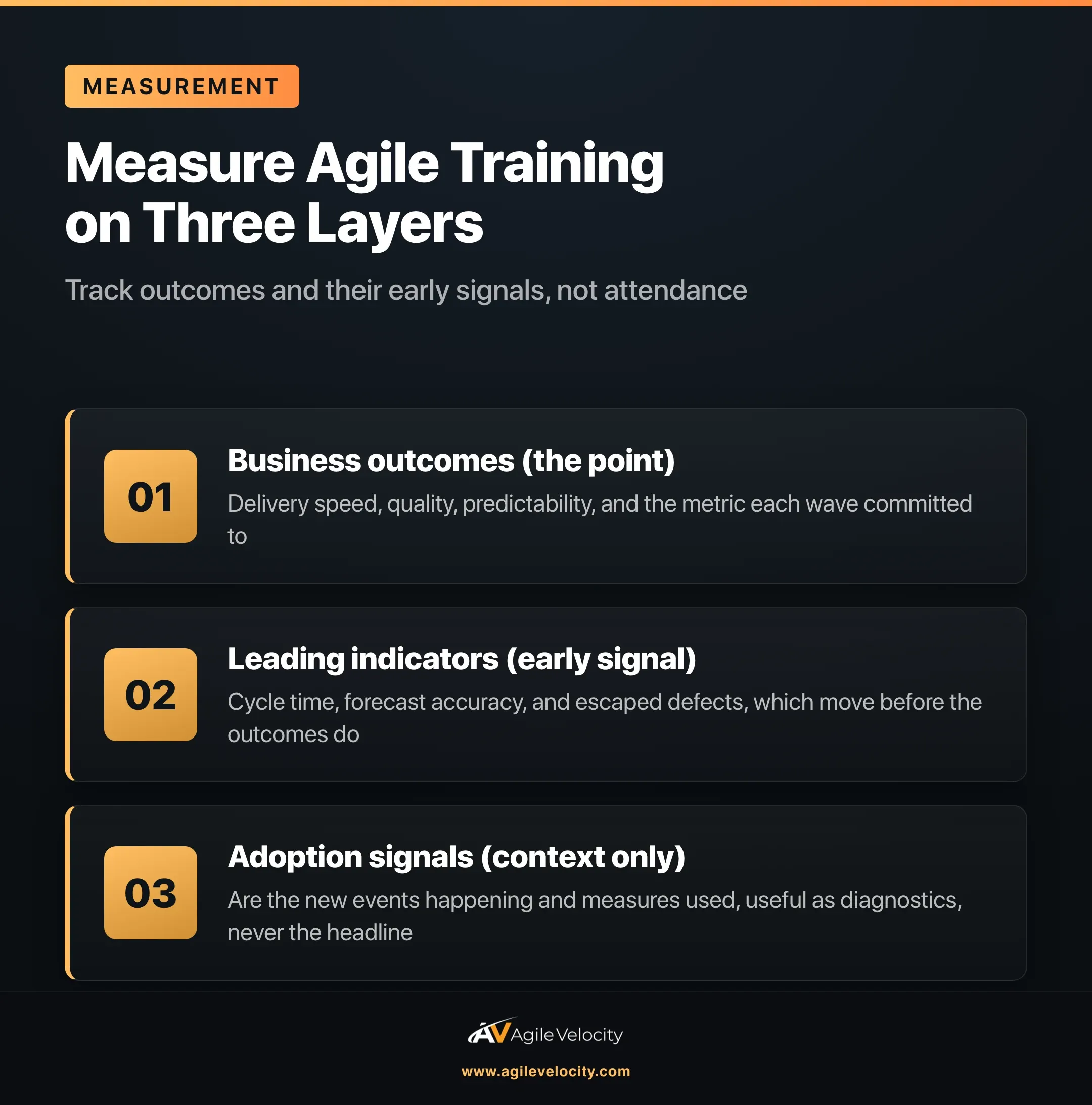
Measure agile training on three layers: business outcomes are the point, leading indicators are the early signal, and adoption signals like attendance and certification counts are context only, never the score. Almost every program inverts that order and scores itself on the layer that proves the least.
Why satisfaction scores and attendance mislead
Satisfaction scores and attendance mislead because they measure whether people enjoyed a day away from their desk, not whether they work differently the following Monday. A room can rate a course 4.8 out of 5 and change nothing about how it plans, builds, or ships.
This is the oldest known problem in training evaluation. Donald Kirkpatrick's four-level model, the most widely cited in training evaluation, names the trap directly. Level 1 is Reaction, and the survey that measures it is so predictably positive it has a nickname: the smile sheet. As the training-evaluation literature puts it plainly, smile sheets are easy, and they are also weak predictors of learning or behavior when used alone. High reaction scores do not reliably produce changed behavior, and the causal chain from "liked it" to "did something differently" is exactly where most programs break.
Attendance is worse, because it is not even a measure of reaction. It is a measure of calendar compliance. Counting seats filled tells you the training happened. It tells you nothing about whether it worked. The same is true of the metric consultancies love to report back to a buyer: the number of people certified. A badge count is attendance with a credential stapled to it. It measures that an individual passed an exam, not that your organization delivers differently.
That distinction is the whole game. Certifications serve the individual and travel with them when they leave. What you are actually buying is a change in how the organization works, and that has to be measured at the level of the system, not the learner's resume.
Leading versus lagging indicators
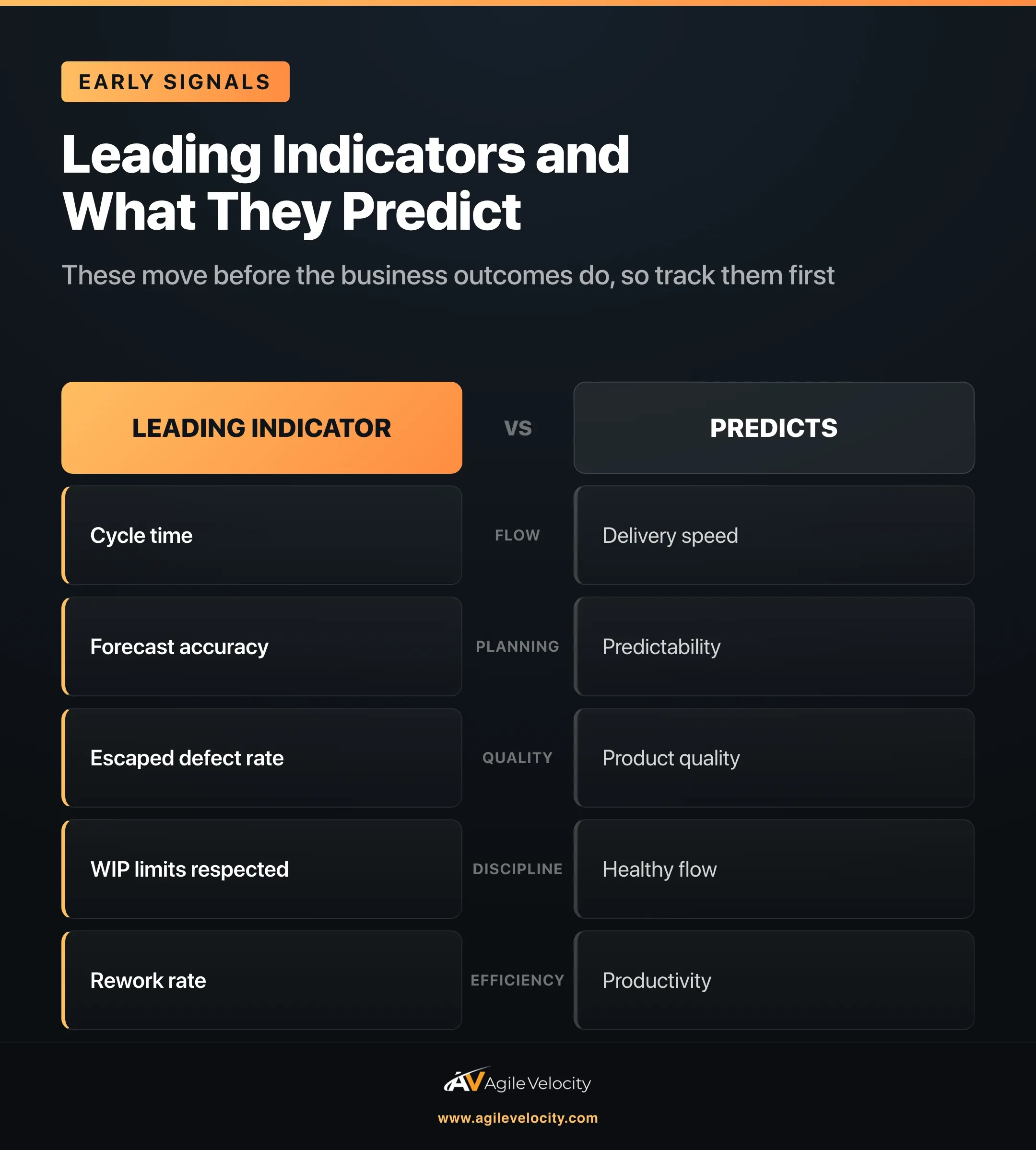
The cleanest way to structure measurement is to separate leading indicators from lagging indicators. Leading indicators are behavior changes you can observe within weeks. Lagging indicators are business outcomes that move over quarters. You need both, because a leading indicator tells you the training is taking hold before the lagging indicator has had time to move.
Leading indicators: is behavior actually changing
Leading indicators answer whether people apply what they learned once they are back on the job. This is Kirkpatrick Level 3, Behavior, and it is the level most organizations skip because it takes more than a survey.
Concrete leading indicators for agile training include:
- Event participation and quality. Are retrospectives producing action items that actually get done, or are they status meetings in disguise? Is refinement happening before planning? Are daily standups surfacing blockers or reciting to-do lists?
- Work-item hygiene. Are stories being sized and split, or are teams still committing to vague, oversized work? Well-formed backlogs are a direct behavioral output of good training.
- Manager observation. Structured observation by team leads and coaches, using a simple checklist of target behaviors, captures whether the practice moved from the classroom to the team room. This is the highest-signal Level 3 measure and it costs almost nothing.
- Work-in-progress limits being honored. Teams that learned flow but ignore WIP limits did not change behavior. Teams that hold the limit did.
Collect these 30 to 60 days after training, while the change is either taking root or quietly dying.
Lagging indicators: did the business outcome move
Lagging indicators are the business results leaders actually fund training to improve. This is Kirkpatrick Level 4, Results. These take longer to move and are the ones that end the budget conversation.
The metrics that matter for agile training:
- Lead time. How long from a request entering the system to it being delivered. Training that improves prioritization, refinement, and flow should shorten it.
- Cycle time. How long a work item takes once a team starts it. This is the most direct measure of whether flow practices stuck.
- Delivery predictability. The gap between what teams commit to and what they deliver. Predictability is often the single most valued outcome for the executives who approve budgets, because it is what lets the business plan.
- Defect rate and escaped defects. Quality practices, test discipline, and definition-of-done rigor should reduce defects found in production over time.
- Retention. Teams that work in a healthier system leave less often. Voluntary attrition on trained teams versus a baseline is a legitimate, and frequently overlooked, business outcome.
These are the numbers that connect a training line item to a business case. They are also why this is a measurement problem, not a satisfaction problem.
How to measure agile training effectiveness with before and after data
Set up before-and-after measurement by capturing a baseline of your target metrics before training begins, running the training, and re-measuring the same metrics on the same teams 60 to 90 days later. The delta, read against your leading indicators, is your evidence. This is not complicated, but it is non-negotiable: without a before number, an after number proves nothing.
A practical sequence:
- Pick two or three business outcomes, not ten. Choose the lagging indicators that leadership already cares about. For most delivery organizations that is cycle time, predictability, and defect rate. Do not try to move everything at once.
- Baseline before you train. Pull four to eight weeks of history on those metrics for the specific teams being trained. If you cannot measure it now, you will not be able to prove it later. Most delivery tools already hold this data.
- Define the target behaviors. Write down the specific practices the training is meant to change, so you have a Level 3 checklist to observe against. This is what turns "did they like it" into "did they do it."
- Train, then protect a measurement window. Re-measure the same teams, same metrics, at 60 and 90 days. Read the behavior checklist at 30 and 60 days so you see the leading signal before the lagging one.
- Use a comparison where you can. If only some teams are trained this quarter, the untrained teams are your control group. A trained-versus-untrained comparison is far more persuasive than a single team's before-and-after.
- Attribute honestly. Business outcomes move for many reasons. Tie the change back to the observed behaviors. If cycle time dropped and you can see WIP limits being honored and refinement happening, the story holds. If the number moved but no behavior changed, be honest that something else did the work.
If you want to translate those metric deltas into a defensible dollar figure, model them with the agile training ROI calculator rather than guessing. Measurement gives you the numbers; the calculator turns them into the business case.
This measurement discipline is also how you should evaluate any training vendor before you hire one. A provider whose only reported outcome is the number of people certified is selling you Level 1. Ask instead how they baseline and re-measure business outcomes, and how they will observe behavior change on your teams. That is the difference between a certification mill and a partner who changes how your organization works. Our private training for organizations and agile coaching are built around exactly this before-and-after model, and the enterprise agile training guide walks through how program design and measurement fit together.
How this connects to Path to Agility
At Agile Velocity, measurement is not an afterthought bolted onto a course. The Path to Agility® approach is built around it. Rather than counting certifications, it defines the capabilities teams and the organization need to build, the measurable outcome path that ladders those capabilities up to business outcomes leaders can evaluate, and the operating-model conditions that keep the change in place after the initial rollout. That is precisely the before-and-after structure this article describes, formalized into a model. Training is the intervention. Changed capability, measured against business outcomes, is the result you are actually buying.
Frequently Asked Questions
What is the best way to measure agile training effectiveness?
The best way is to measure behavior change and business outcomes, not satisfaction or attendance. Baseline metrics like cycle time, delivery predictability, and defect rate before training, observe target behaviors at 30 to 60 days, and re-measure the business metrics at 60 to 90 days. The delta, tied to observed behavior, is your evidence.
Why are satisfaction surveys not enough to measure training?
Satisfaction surveys measure reaction, which is Level 1 of the Kirkpatrick model and the weakest predictor of whether behavior actually changed on the job. A course can score highly and change nothing about how teams plan, build, and ship. Reaction tells you people enjoyed the session, not that the organization now works differently.
What business metrics show that agile training worked?
The clearest business metrics are lead time, cycle time, delivery predictability, defect rate, and team retention. These are lagging indicators that leaders fund training to improve. Pair them with leading indicators such as event quality, work-item hygiene, and honored work-in-progress limits so you can see behavior change before the business numbers move.
How long after training should we measure results?
Measure on intervals. Assess reaction and learning immediately, observe behavior change at 30 to 60 days while the practice is taking root or dying, and measure business outcomes at 60 to 90 days and again at six months. Business results are lagging indicators and need time to move, so a single measurement the week after class will understate the impact.
Is the number of people certified a good measure of training success?
No. A certification count measures that individuals passed an exam, not that your organization delivers differently. Certifications travel with the individual and prove nothing about system-level behavior change. Measure the organization's delivery metrics instead, because that is the outcome an enterprise buyer is actually paying for.
Facing These Challenges First-Hand?
We've guided 100+ organizations through transformation. Let's talk about what's happening with yours.
Start a ConversationFacing These Challenges First-Hand?
We've guided 100+ organizations through transformation. Let's talk about what's happening with yours.
Start a Conversation

