 Eric Cussen
The right enterprise agile training vendor is not the one with the longest list of certifications or the lowest per-seat price. It is the one that can change how your organization works and prove it in business outcomes. If you evaluate vendors on badge count and seat cost, you are optimizing for the wrong buyer and you will get a room full of certified people whose day-to-day behavior does not change.
An enterprise agile training vendor is a partner that trains and coaches your teams to change how they deliver software, measured against business outcomes rather than the number of individual certifications issued. This is a buyer's guide for the people who own that decision: VPs of engineering, transformation leads, and the L&D and procurement partners who evaluate the shortlist. The agile training market is crowded with certification bodies and course aggregators, and almost all of them are built to sell an individual a credential. Enterprise change is a different purchase, and it needs different criteria.
Key Takeaways
- BCG's analysis of roughly 895 companies found only about 30 percent of transformations succeed, so vendor selection is a bet on the 70 percent risk, not a training procurement.
- Certification counts and per-seat price measure the wrong thing: they serve the individual credential holder, not organizational capability change.
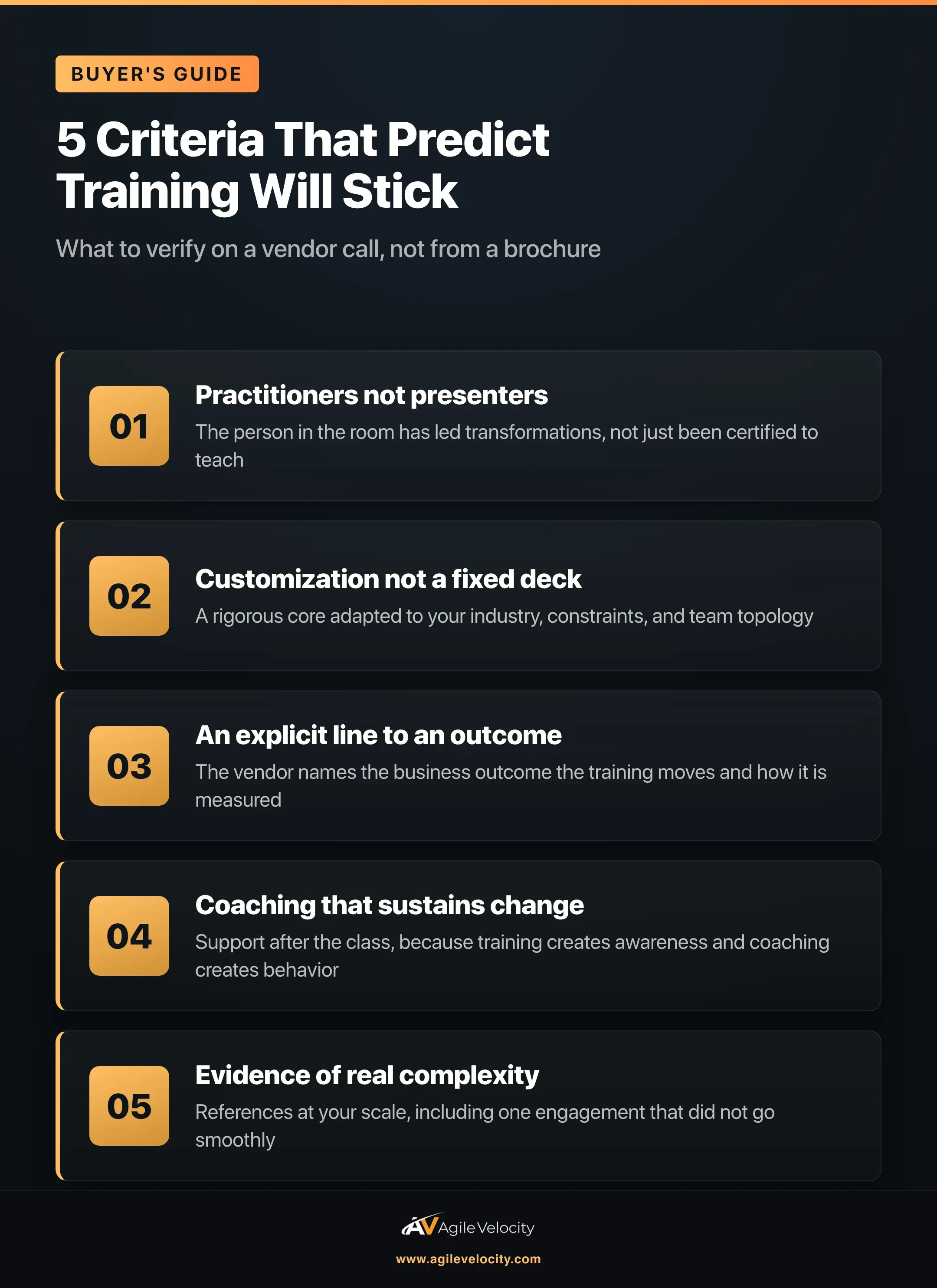
- The five criteria that predict success are practitioners over presenters, customization over fixed curriculum, an explicit line to business outcomes, coaching that sustains the change, and evidence of real enterprise complexity.
- Ask every vendor to name the outcome the training moves and how they will measure it. If they cannot, they are selling a course, not a capability.
- Retention depends on what happens after the class, so a vendor that only delivers training has no visibility into whether behavior actually changed.
Why the crowded market is built for the wrong buyer
The agile training market is optimized to sell credentials to individuals. Certification bodies license a curriculum, aggregators resell seats at volume, and both are measured on throughput: how many people passed, how many badges issued, how low the price got. That is a fine business. It is just not the business of changing how a 3,000-person engineering organization delivers software.
An individual buys a certification to advance a career. An enterprise buys training to change an operating model, and those two goals pull in opposite directions. The individual wants a portable, standardized badge. The organization wants its specific teams to do specific things differently on Monday, measured against outcomes leaders actually care about: speed, quality, predictability. A vendor tuned to maximize badge throughput has no structural reason to care whether your delivery got faster. Their scoreboard already reads "pass."
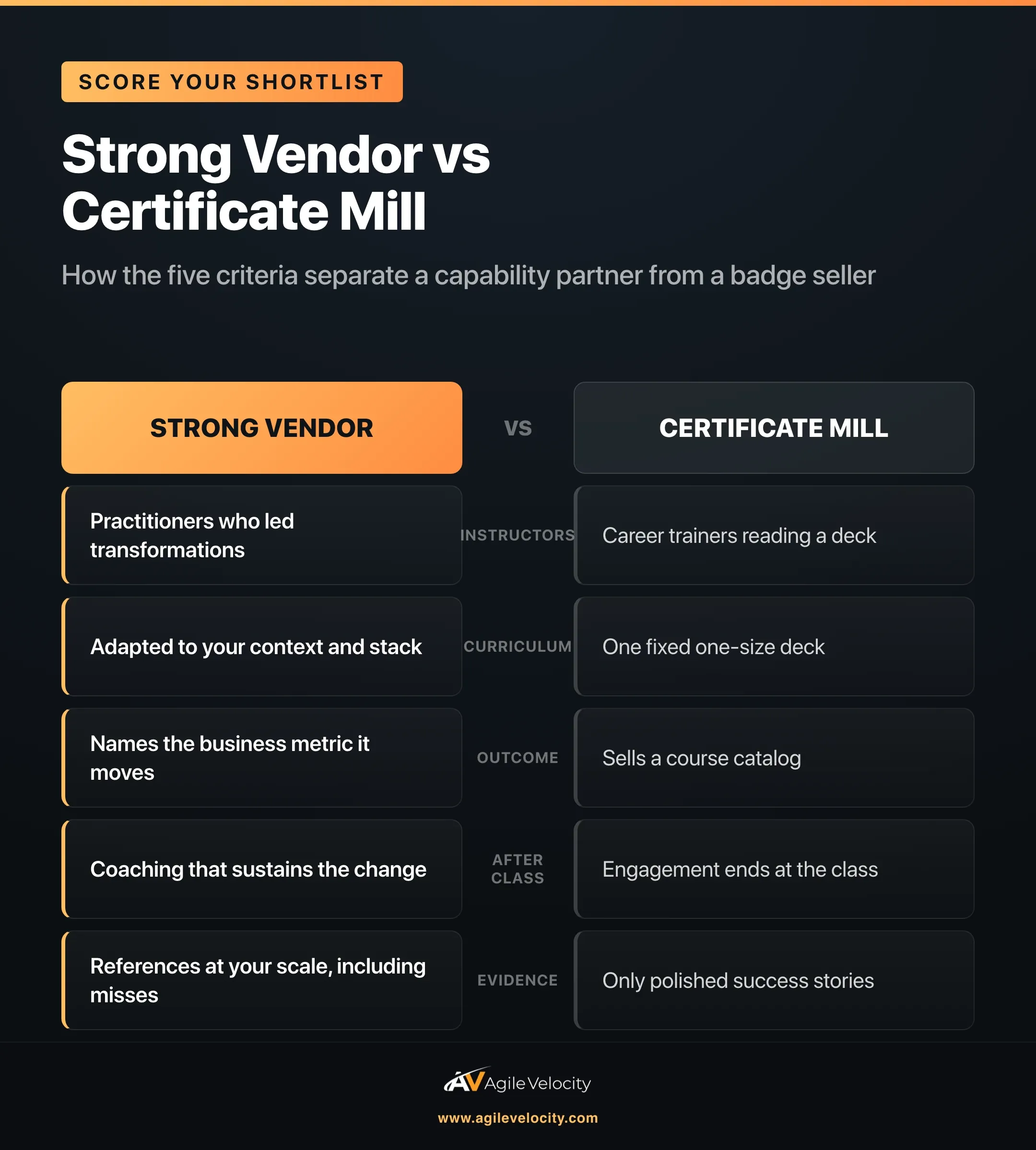
This is why the two most common selection criteria, certification count and per-seat price, are misleading. A high certification count tells you a vendor can move volume through a standardized curriculum. It tells you nothing about whether they can adapt that curriculum to your context or coach it into daily practice. And aggressive per-seat discounting is rarely a sign of efficiency. It usually signals underqualified instructors, a commoditized model, and no investment in curriculum depth or follow-through. You are not buying seats. You are buying a change in capability, and capability does not go on sale.
We take a hard position on this at Agile Velocity: certifications serve the individual, and transformation serves the organization. We are not a certification mill. We measure our work by whether your business outcomes moved, not by how many badges we handed out. That distinction is the entire point of this guide.
The five criteria that predict success
Five criteria predict whether enterprise agile training will stick: practitioners over presenters, customization over a fixed curriculum, an explicit line to a business outcome, coaching that sustains the change, and evidence of real enterprise complexity. Each one is framed as something you can verify on a vendor call, not a claim a brochure can make for free.
Practitioners who have done the work not presenters who have memorized the deck
The single most reliable signal is whether the person in front of your teams has actually led transformations, or has only been certified to teach about them. A presenter can deliver the standard curriculum flawlessly and still freeze the moment a senior engineer asks, "That is fine in theory, but our release train is gated by a compliance review we cannot move. Now what?" A practitioner has lived that exact problem and can teach through it.
Ask who specifically will be in the room, and ask about the transformations they personally led, not the courses they are accredited to deliver. Enterprise engineers and managers can smell a career trainer within the first hour, and once they do, they disengage. The credibility of the instructor is the credibility of the training.
Customization to your context not a fixed curriculum
A fixed, one-size curriculum is the tell of a vendor built for volume. The strongest programs keep a rigorous core and adapt the rest to your reality: your delivery frameworks, your regulatory constraints, your team topology, the specific dysfunction you are trying to fix. Modular design that preserves rigor while allowing relevance gives you both.
Ask what they change when they walk into a bank versus a healthcare system versus a product company, and listen for whether the answer is concrete. "We tailor the case studies and the working sessions to your value streams" is a real answer. "Our curriculum is comprehensive enough to cover any industry" is a way of saying they do not customize. For a deeper look at what a tailored engagement looks like, see our approach to training for organizations.
An explicit line from the training to a business outcome
Enterprise training has to connect to something a leader can evaluate. Before the first session, a good vendor will ask which outcome you are trying to move, speed, quality, predictability, engagement, and design the program backward from that. A weak vendor sells you a catalog and lets you sort out the relevance later.
This is where the Path to Agility approach starts, and it is why we lead every engagement with the outcome, not the curriculum. Path to Agility® operationalizes and measures the organizational evolution: the capabilities teams need to build, the measurable outcome path those capabilities ladder up to, and the operating-model alignment that sustains the change past initial rollout. Ask any vendor to name the specific business outcome their training is designed to move and how they will know it moved. If they cannot answer, they are selling a course, not a capability.
Coaching that makes the change stick
Training creates awareness. Coaching creates behavior change. The gap between the two is where most transformation budgets go to die. People leave an energizing three-day class, return to the same structures, incentives, and pressures that produced the old behavior, and revert within weeks. The strongest predictor of retention is whether the vendor also coaches implementation after the class.
A training-only vendor has a structural blind spot: they never see whether their graduates apply anything, because their engagement ends when the class does. Ask how the vendor supports teams in the weeks and months after training, and whether the same people who taught the class stay involved. Our view on why the agile coaching relationship is inseparable from training is exactly this: the class opens the door, and coaching is what walks the organization through it.
Evidence of real enterprise complexity
Finally, look for scar tissue: evidence the vendor has survived real enterprise complexity, not just single-team pilots. Enterprise transformation means multiple teams, competing priorities, regulatory constraints, legacy systems, and executives who need to see progress in a language they understand. A vendor whose experience is mostly single-team or startup-scale will struggle with the coordination problems that define enterprise work.
Ask for references from organizations of similar size, industry, and complexity, and ask what went wrong in those engagements and how they handled it. A vendor who only tells you success stories has either not done enough enterprise work to have failed, or is not being straight with you. Both are disqualifying.
What questions should you ask an enterprise agile training vendor?
Compress the five criteria into six questions and judge the vendor on the answers. Specific and grounded beats vague and rehearsed, and the gap between the two tells you almost everything.
- Who specifically will be in the room, and which enterprise transformations did that person personally lead?
- What do you change in the curriculum for our industry and our delivery frameworks?
- Which business outcome is this training designed to move, and how will we measure whether it moved?
- What happens in the weeks after the class to make the change stick, and do the same people stay involved?
- Can you give us two references at our scale and complexity, including one engagement that did not go smoothly?
- How do you price, and what is included beyond seat time?
If a vendor answers the outcome question with a course catalog, or the "who is in the room" question with a certification count, you have your answer. If you want to translate these criteria into a budget case, our training ROI calculator helps you model the cost of training against the outcome it is meant to move, which is the framing every one of these questions is built around.
Frequently Asked Questions
What is the most important criterion when choosing an enterprise agile training vendor?
Whether the vendor connects the training to a specific business outcome and can measure it. Certification counts and per-seat price are easy to compare but predict nothing. An explicit line from the training to speed, quality, or predictability, plus coaching to sustain it, is what separates a course from a capability change.
Should we choose a vendor based on how many certifications they offer?
No. Certification volume signals that a vendor can move people through a standardized curriculum efficiently. It says nothing about whether they can adapt that curriculum to your context or coach it into daily practice. Certifications serve the individual credential holder. Enterprise transformation is about changing how the organization works, which is a different purchase.
How is enterprise agile training different from individual agile certification?
An individual certification is a portable, standardized credential that advances a career. Enterprise training is designed to change how specific teams work and to move business outcomes leaders can evaluate. The two goals pull in opposite directions, which is why a vendor optimized for badge throughput is usually the wrong choice for organizational change.
Why does coaching matter if the training is good?
Training creates awareness, but coaching creates behavior change. People return from class to the same structures and incentives that produced the old behavior and revert within weeks. A vendor that also coaches implementation sees whether graduates actually apply what they learned. A training-only vendor's engagement ends before you find out whether anything changed.
What questions should procurement ask agile training vendors?
Ask who specifically will teach and what enterprise transformations they led, what the vendor customizes for your industry, which business outcome the training targets and how it will be measured, what happens after the class to sustain the change, and for references at your scale including one engagement that did not go smoothly.
Facing These Challenges First-Hand?
We've guided 100+ organizations through transformation. Let's talk about what's happening with yours.
Start a ConversationWhere Does Your Organization Actually Stand?
18 questions. 4 minutes. Get scored across 9 Business Outcomes and see exactly where to focus.


