 Eric Cussen
If you are scaling agile without a framework, the goal is not to avoid structure. The goal is to stop treating structure as the point. A better way of working is measured by business outcomes like speed, quality, and predictability, not by how faithfully your organization performs the roles, events, and artifacts a heavy framework prescribes. Many leaders who have been burned by a large rollout reach the same conclusion: they bought a framework and got overhead, and the outcomes never showed up.
This does not make every scaling framework wrong. A delivery framework can genuinely reduce coordination cost when the problem it solves is the problem you actually have. The failure mode is subtler than "framework bad." It is adopting a framework for its own sake, then measuring success by adherence to the framework instead of by the results the framework was supposed to produce. This post gives you a decision rule for when a framework earns its overhead, and a capability-based alternative for when it does not.
Key Takeaways
- The goal of scaling is better business outcomes (speed, quality, predictability), not conformance to a framework's roles, events, and artifacts.
- SAFe reached a record 53% share among organizations using a scaling method (Digital.ai State of Agile), yet dominance is not the same as fit.
- A delivery framework helps when coordination cost is your real bottleneck; it becomes overhead when it is adopted to look agile rather than to change how work flows.
- Capability-based scaling asks which specific abilities your organization lacks, then builds only those, measured against outcomes.
- Path to Agility ties 100 capabilities to 26 Agile Outcomes and 9 Business Outcomes, so leaders can evaluate progress by results instead of by badges earned.
What does scaling agile without a framework actually mean?
Scaling agile without a framework means treating scaling as an outcomes problem, not a rollout problem. Instead of installing a prescribed operating model across every team and grading fidelity to it, you identify the specific coordination and capability gaps slowing your organization down, close only those, and measure success by movement in business outcomes like speed, quality, and predictability.
Scaling frameworks became popular because coordinating many teams is genuinely hard. When Team A cannot ship until Team B and Team C finish, someone has to sequence the work, surface dependencies, and align on priorities. A framework packages a set of answers to that problem: cadences, planning events, roles, and portfolio structures. That packaging has real value when the coordination problem is severe and your teams lack a shared way to solve it.
The trouble starts when the framework becomes the deliverable. Teams start reporting on how well they run the events rather than on whether value is flowing faster. Leaders ask "are we doing PI Planning correctly" instead of "did our time-to-market improve." The framework quietly shifts from a means to an end, and every role, artifact, and approval layer it adds is now overhead you are paying for whether or not it moves an outcome.
Why do heavy scaling frameworks generate overhead at scale?
Heavy frameworks add overhead when they introduce more roles, artifacts, and approval layers than your actual coordination problem requires. The cost is not the framework's existence; it is the mismatch between the process you install and the friction you have.
Three patterns show up repeatedly in large rollouts:
Bureaucracy masquerading as agility
A common criticism of the largest scaling frameworks is that they let an organization keep its existing hierarchy and hand-offs while relabeling them with agile vocabulary. The org chart barely moves, but now there are more meetings, more coordination roles, and more documents describing the coordination. Teams feel busier and less able to change direction. That is the opposite of what scaling was supposed to buy you.
Coordination cost that cancels the speed gain
Adding teams should add capacity. Too often it adds drag, because every new team increases the number of dependencies to manage, and a heavy framework responds by adding more synchronization events and more governance. Past a certain point, the coordination machinery consumes the throughput the extra teams were meant to create. You have more people and the same, or slower, delivery.
Measuring adherence instead of results
The most expensive pattern is cultural. When a framework is the goal, the whole system optimizes for conformance. Coaches audit whether teams follow the prescribed events. Dashboards track framework compliance. Nobody is accountable for whether quality went up or lead time went down, because the implicit theory is that doing the framework correctly will automatically produce those results. It does not, and by the time leaders notice, the transformation is measured in certificates earned rather than outcomes delivered.
This last pattern is where the certification-mill economy thrives. It is easy to sell thousands of individual badges that prove a person can recite a framework. It is much harder, and much more valuable, to change how an organization actually works. A certificate serves the individual's resume. It does not, on its own, move your delivery speed or your defect rate.
When does a delivery framework genuinely help?
A delivery framework helps when coordination across many teams is your binding constraint and your teams do not yet share a way to manage it. In that situation, a proven framework like Scrum, Kanban, SAFe, or LeSS gives everyone a common language, cadence, and set of practices faster than inventing your own.
Use a framework on purpose when several of these are true:
- You have enough interdependent teams that dependencies, not individual team performance, are the main thing slowing delivery.
- Your teams lack a shared vocabulary and cadence, so every coordination conversation starts from scratch.
- You need a known-good starting point quickly and do not have the internal expertise to design one.
- Leaders are prepared to adapt the framework as they learn, and to drop the parts that do not earn their keep.
Notice the last condition. A framework helps most when it is treated as a starting scaffold you will modify, not a standard you must pass an audit against. Teams that begin with Scrum, hit coordination limits, adopt a scaling framework, and then deliberately remove the parts that add no value tend to end up leaner and faster than teams that adopt the whole thing and defend it. If you are still deciding which framework fits, our guides on choosing the right agile framework and comparisons like SAFe versus LeSS can narrow the field before you commit.
The dividing line is intent. A framework that reduces coordination cost is doing its job. A framework kept because leadership is invested in the rollout, or because consultants are certified in it, or because switching would look like failure, has become overhead. The framework has not changed. Your reason for keeping it has.
What is the capability-based alternative to a scaling framework?
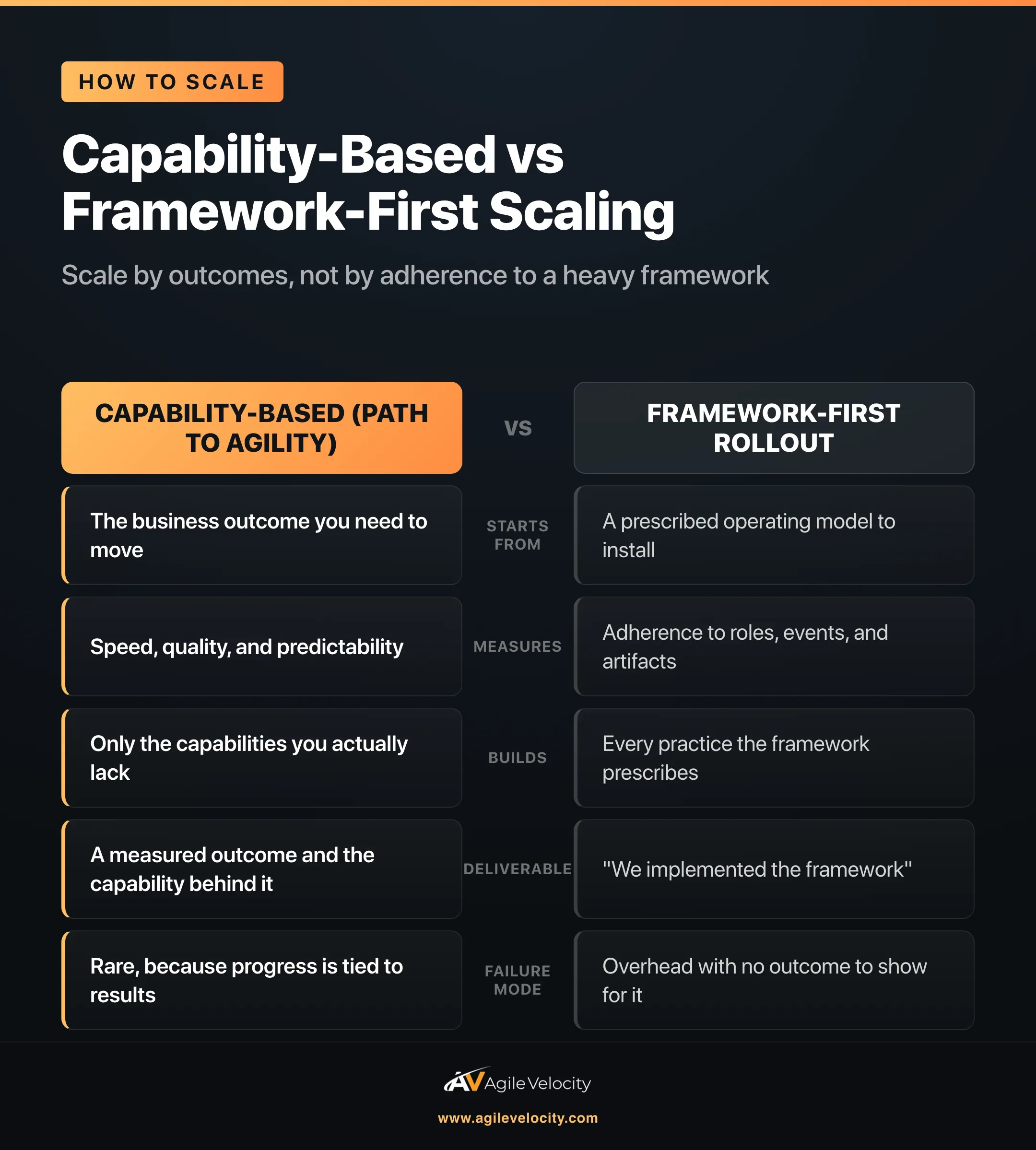
The capability-based alternative starts from the outcome you need and works backward to the specific abilities your organization must build to get there. Instead of installing a framework and hoping outcomes follow, you name the business outcome, identify the missing capabilities blocking it, and build only those, measuring progress against the outcome the whole time.
This is the Path to Agility approach, and it is deliberately not a framework. Path to Agility® operationalizes and measures organizational evolution across three connected things: the capabilities teams and the broader organization need to build, the measurable outcome path those capabilities ladder up to, and the operating-model alignment that keeps the change in place after the initial push. Concretely, it connects 100 capabilities to 26 Agile Outcomes, which roll up to 9 Business Outcomes leaders can actually evaluate: employee engagement, customer satisfaction, quality, speed, predictability, innovation, market responsiveness, productivity, and continuous improvement.
The practical difference for a skeptical leader is what you are on the hook for. Under a framework-first rollout, the deliverable is "we implemented the framework." Under a capability-based approach, the deliverable is "predictability improved, and here is the specific capability we built to make that happen." You can still use Scrum, Kanban, or a scaling framework as the delivery mechanism inside a team or program. The difference is that the delivery framework is now a tool serving a measured outcome, not the thing you are scaling for its own sake.
Three principles make this work:
- Outcome first. Every scaling effort names the business outcome it exists to move before any structure is chosen. If nobody can say which outcome improves, the effort has no reason to exist.
- Only the capabilities that move it. You assess where the organization actually is against the capabilities that drive that outcome, then build the missing ones. You do not install practices your teams do not need just because a framework includes them.
- Measured continuously. Progress is tracked as movement in the outcome and the underlying capabilities, not as framework compliance. That keeps the effort honest and lets you stop paying for overhead the moment it stops earning results.
This is also why coaching matters more than certification for scaling. Building capability into how an organization works is hands-on, contextual, and specific to your constraints. Our agile coaching engagements are designed to build durable capability inside your teams and leadership rather than to hand out credentials, and for a broader view of how the pieces fit together, the enterprise agile training guide lays out the full picture.
How do I choose between a framework and a capability-based approach?
Choose based on your real constraint. If your bottleneck is that many teams cannot coordinate and lack a shared method, a delivery framework can give you that method fast. If your bottleneck is that you keep adopting structure without moving outcomes, more framework will not help, and a capability-based approach will.
In practice the two combine. Most healthy scaling efforts use a delivery framework as scaffolding at the team and program level, inside a capability-based, outcome-measured approach at the organization level. The framework handles mechanics. The capability model keeps you honest about whether any of it is working. What you avoid is the trap that burned you before: scaling a framework because the framework is the plan, and discovering a year later that you have more process and the same results.
If you are unsure which situation you are in, that is worth a conversation. The answer usually turns on two questions: what specific outcome are you trying to move, and what is actually stopping you from moving it today.
Frequently Asked Questions
Can you scale agile without any framework at all?
Yes, but you still need structure. Scaling without a framework means you are not adopting a prescribed operating model wholesale; it does not mean abandoning cadence, coordination, and shared practices. The stronger move is to keep useful structure (planning cadence, dependency management, clear priorities) while measuring success by business outcomes rather than by adherence to a named framework. You supply the structure your specific coordination problem needs and nothing more.
Is SAFe bad for scaling agile?
No, SAFe is not inherently bad, and it remains the most widely used scaling method: SAFe reached a record 53% share among organizations using a scaling method (Digital.ai State of Agile). It adds overhead when it is adopted to look agile while leaving hierarchy and hand-offs intact, or when success is measured by how correctly teams run the events rather than by whether delivery improved. Used deliberately, and trimmed to your actual coordination problem, it helps.
What is a capability-based approach to scaling agile?
A capability-based approach starts from the business outcome you need, identifies the specific organizational capabilities blocking that outcome, and builds only those, measuring progress against the outcome the entire time. Path to Agility is one such model. It links 100 capabilities to 26 Agile Outcomes and 9 Business Outcomes, so leaders evaluate scaling by results (speed, quality, predictability) instead of by framework compliance or certificates earned.
Why do agile transformations stall after adopting a scaling framework?
They stall most often because the framework becomes the goal. Once success is defined as running the framework correctly, the organization optimizes for conformance instead of results, adds coordination overhead as it grows, and loses the ability to tell whether outcomes are improving. Reconnecting the effort to measurable business outcomes, and cutting the framework overhead that does not move them, is usually what gets a stalled transformation moving again.
Start a conversation about your scaling challenge.
Facing These Challenges First-Hand?
We've guided 100+ organizations through transformation. Let's talk about what's happening with yours.
Start a ConversationWhere Does Your Organization Actually Stand?
18 questions. 4 minutes. Get scored across 9 Business Outcomes and see exactly where to focus.


