 Bhavani Krishnan
![The 5 Levels of Iterative Planning [Infographic]](/_next/image?url=%2Fimages%2Fblog%2FIterative-Planning-Infographic-Header-Image.png&w=2048&q=75)
Most organizations think they have a planning problem when what they actually have is a levels problem. They plan at one or two levels and wonder why execution falls apart.
Agile planning is not a single event. It happens at five distinct levels, each with a different cadence, audience, and purpose. Skip a level and you get misalignment. Treat any level as a formality and you get plans that nobody follows.
(Click here to enlarge the infographic for download)
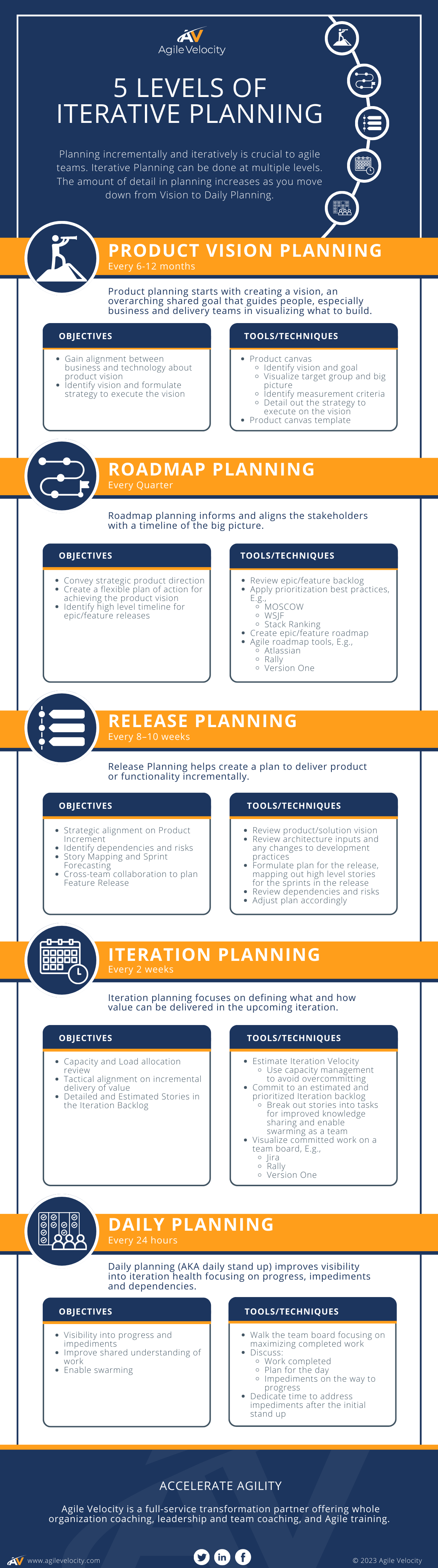
Level 1: Product Vision Planning
The longest-range view in the model. Product and business leadership define a shared product vision: what problem the product solves, who it serves, and which Business Outcomes it needs to drive over the next year.
The mistake most organizations make here is treating vision as a document that gets created once and filed away. A useful product vision is a living conversation that gets revisited as the market shifts. The question is not "what was the original plan?" but "given what we now know, is the vision still the right one?"
Cadence: Every 6-12 months Key tools: Product vision statement, Business Outcome alignment, strategic themes Who's involved: Product leadership, executive stakeholders
Level 2: Roadmap Planning
The roadmap translates the product vision into time-phased outcomes: which capabilities need to land in the next quarter, which can wait, and which dependencies have to be resolved first. A roadmap is not a release schedule. It's a directional commitment about which Business Outcomes get focus next.
The most common dysfunction here is treating the roadmap as a fixed feature list with hard dates. That turns a planning tool into a delivery commitment, which breaks the moment reality intervenes. An agile roadmap captures intent and sequence, not promises.
Cadence: Quarterly Key tools: Outcome-based roadmap, capability sequencing, dependency mapping Who's involved: Product management, engineering leadership, portfolio stakeholders
Track Your Transformation in Real Time
Path to Agility Navigator maps your teams against 100 capabilities and shows exactly where to invest for the outcomes you need.
Level 3: Release Planning
Here, multiple teams coordinate around a shared set of objectives for the next release or planning increment (typically 8-12 weeks). This is the level where cross-team dependencies surface, risks get identified, and teams negotiate commitments.
Organizations that skip this level end up with teams that are individually productive but collectively misaligned. Each team delivers what it committed to, but the pieces don't fit together. Release planning creates the cross-team alignment that daily standups and sprint reviews cannot.
Cadence: Every 8-12 weeks Key tools: Release plan, PI Planning, dependency boards, program boards Who's involved: Teams, product owners, system architects, management
Level 4: Iteration Planning
The most familiar level for Scrum teams. A single team selects work for the next 1-4 week sprint based on priority, capacity, and the sprint goal. The planning conversation is about what can we deliver and how will we approach it.
The most common dysfunction here is treating sprint planning as a task-assignment meeting rather than a collaborative planning conversation. When the product owner dictates and the team estimates, you get compliance instead of commitment. Real sprint planning produces a sprint goal that the team owns.
Cadence: Every 1-4 weeks Key tools: Sprint backlog, sprint goal, capacity planning, story decomposition Who's involved: Scrum team (developers, product owner, scrum master)
Level 5: Daily Planning
The shortest cadence. Teams coordinate daily to identify blockers, adjust the plan, and maintain focus on the sprint goal. The daily standup is the most visible expression of this, but it extends to any real-time coordination the team needs.
The dysfunction at this level is well-known: status reporting to a manager instead of peer-to-peer coordination. When the daily standup becomes "tell the scrum master what you did yesterday," it has stopped being planning and become surveillance.
Cadence: Daily Key tools: Daily standup, task boards, burndown/burnup charts Who's involved: The team
How the Five Levels Connect
Each level feeds the one below it and receives feedback from the one above. Vision informs roadmap decisions. Roadmap decisions shape release objectives. Release objectives drive iteration goals. Iteration goals guide daily coordination.
When organizations only plan at the team level (Levels 4 and 5), teams stay busy but leadership has no visibility into whether that work connects to the product vision. When organizations only plan at the top (Levels 1 and 2), the vision looks great on slides but never reaches the teams doing the work.
The organizations that achieve predictability and speed are the ones that operate at all five levels in concert, with each level informing the others. This is the progression the Path to Agility® framework calls Predict to Accelerate: you cannot optimize the system until a predictable cadence is in place at every level.
Getting Started
If your organization only plans at one or two levels today, don't try to add all five at once. Start by identifying which level is weakest:
- Teams are busy but leadership can't see progress? You're missing Level 2 or 3.
- Product vision exists but teams don't know about it? The connection between Level 1 and Level 4 is broken.
- Teams deliver on time but the wrong things ship? Level 3 alignment is missing.
- Daily standups feel pointless? Level 5 has become a ritual instead of a planning tool.
Each gap tells you exactly where to focus. If you want help identifying which levels need attention in your organization, take our Organizational Health Check to get a scored assessment across 9 Business Outcomes and pinpoint where the planning breakdowns are happening.
Where Does Your Organization Actually Stand?
18 questions. 4 minutes. Get scored across 9 Business Outcomes and see exactly where to focus.


